community Service means Business!

31 January 2011

Empathy, Human Evolution, and our Technological Future

via Sociological Images by Lisa Wade on 1/30/11


Benedict Anderson coined the phrase “imagined communities” to point to the way that humans believe they are meaningfully connected, by virtue of some commonality, to people they will never know, and may have very little in common with.  He applied the idea to the nation.  Why do all of the citizens of China, for example, have in common with other citizens of China?  In some cases little, other than their citizenship.  Yet, the fact that “we are all Chinese” can motivate many people to do and feel things.

In an RSA video featuring Jeremy Rifkin, sent in by Dmitriy T.M., it is argued that the human ability to imagine a community is a neurological capacity for empathy that has evolved, both neurologically and socially, throughout human existence.  First, he argues, we identified with close relatives, then with our religious community, and later with our nation-state.  Our future, then, he argues, is dependent on our ability to imagine the whole world as a community.  New technologies may very well enable this and Rifkin has his fingers crossed.

(View original at http://thesocietypages.org/socimages)

Posted via email from jimuleda's posterous

26 January 2011

Eight Lessons from the life and work of Jack LaLanne

via Seth's Blog by Seth Godin on 1/25/11

  1. He bootstrapped himself. A scrawny little kid at 15, he decided to change who he was and how he was perceived, and then he did. The deciding was as important as the doing.
  2. He went to the edges. He didn't merely open a small gym, a more pleasant version of a boxing gym, for instance. Instead, he created the entire idea of a health club, including the juice bar. He did this 70 years ago.
  3. He started small. No venture money, no big media partners.
  4. He understood the power of the media. If it weren't for TV, we never would have heard of Jack. Jack used access to the media to earn trust and to teach. And most of what Jack had to offer he offered for free. He understood the value of attention.
  5. He was willing to avoid prime time. Jack never had a variety show on CBS. He was able to change the culture from the fringes of TV.
  6. He owned the rights. 3,000 shows worth.
  7. He stuck with the brand. He didn't worry about it getting stale or having to reinvent it into something fresh. Jack stood for something, which is rare, and he was smart enough to keep standing for it.
  8. Jack lived the story. He followed his own regimen, even when no one was watching. In his words, “I can’t die, it would ruin my image.”

He died last week at 96. I don't think he has to worry about ruining his image, though.

Posted via email from jimuleda's posterous

7 January 2011

Imprisonment is not Healthy for You

via The Real Cost of Prisons Weblog by lois on 1/6/11

Prisoners at Supermax Ohio Penitentiary Begin Hunger Strike to Protest 17+ Year Solitary Confinement
1-6-11

Four prisoners in the supermax Ohio State Penitentiary have launched a hunger strike to protest what they call their harsh mistreatment under solitary confinement. The prisoners—Bomani Shakur, Siddique Abdullah Hasan, Jason Robb and Namir Abdul Mateen—were sentenced to death for their involvement in the 1993 prison uprising in Lucasville, Ohio. For over 17 years, they have been held in 23-hours-a-day solitary lockdown. On Monday, the four began refusing to eat meals until they are moved out of solitary confinement and onto death row, where they say they will get better treatment. We speak with longtime peace activist, historian and lawyer, Staughton Lynd. In 2004, he wrote the definitive history of the 1993 Ohio prison uprising at Lucasville.

AMY GOODMAN: Four prisoners in the supermax Ohio State Penitentiary have launched a hunger strike to protest what they call their harsh mistreatment under solitary confinement. The prisoners—Bomani Shakur, Siddique Abdullah Hasan, Jason Robb and Namir Abdul Mateen—were sentenced to death for their involvement in the 1993 prison uprising in Lucasville, Ohio. For 11 days, over 400 prisoners staged a riot against prison conditions. Nine prisoners and a guard were killed. It was the bloodiest prison riot since Attica. Hasan and Robb were sentenced to death, despite helping negotiate an end to the uprising, and supporters say all four were wrongly convicted.
For over 17 years, they’ve been held in 23-hour-a-day solitary lockdown. On Monday, the four began refusing to eat meals until they’re moved out of solitary confinement and on to death row, where they say they’ll get better treatment. In a statement, one of the prisoners, Bomani Shakur, said, quote, "We have undergone penalty on top of penalty; been kept from fully participating in our appeals, from touching our friends and families; denied adequate medical treatment; and so many other things that are too numerous to name. In a word, we have been tortured."

For more, we’re going to Ohio, where we’re joined by the historian, lawyer, labor activist and Quaker pacifist Staughton Lynd. In the ’60s he taught history at Spelman College in Georgia alongside Howard Zinn and helped direct the Mississippi Freedom Schools. In April 1965, he spoke at the first March on Washington against the Vietnam War and became an early leader of the antiwar movement. Since the 1970s, Staughton Lynd has focused extensively on labor and prison issues. In 2004, he wrote the definitive history of the 1993 Ohio prison uprising at Lucasville.

Staughton Lynd, welcome to Democracy Now! This is very bleak, to say the least, to have these four prisoners say that they would rather be on death row than where they are now. For an audience around the world who is not familiar with the Ohio State Penitentiary, describe why these men are in prison and why they’re in this prison.
STAUGHTON LYND: Well, they are in prison for various crimes, but they are all in this prison because of their alleged leadership of the 1993 uprising. And they are held in more restrictive confinement than the more than 100 other death sentence prisoners in the same prison. Now, why is this? It’s precisely because the system thinks of them as leaders. So, it will let them watch television. They even let Bomani Shakur use a typewriter. But what they don’t let any of the four men do is to be in the same space as another human being other than a guard at the same time. And this means that while other death sentence prisoners can wander about the pod, can have collective meals outside their cells, and especially can have semi-contact visits with their friends and families, the four are always obliged to encounter the world either through a solid cell door or, when they go out on a visit, through a solid pane of glass. So that, again, Bomani has a niece and nephew aged eight and three that he loves and would wish to touch. If he were on death row, he could do that. But he’s been told by the prison authorities he will never be on death row, because they’re going to keep him in social isolation until they kill him.

AMY GOODMAN: Meaning he is on death row, but just not physically. He is sentenced to die, but he is not actually on the row.

STAUGHTON LYND: Precisely. And so, these men feel that they’ve been given the ultimate punishment of death and then something more.
AMY GOODMAN: Now, to understand where they are, how this prison was even built, what a supermax means, let’s go back to, well, the subject of your book, Lucasville: The Untold Story of a Prison Uprising. What happened in 1993?

STAUGHTON LYND: Well, in 1990, at Lucasville, which was Ohio’s maximum-security prison—not supermax, maximum—there was a dreadful incident and, I would add, an ambiguous incident, perhaps not completely understood, where a black male prisoner followed a white teacher into the women’s restroom, and as white officers sought to break down the door, with all sorts of rape fantasies in their minds, the prisoner cut the woman’s throat. And that triggered a so-called Operation Shakedown. A new warden was brought in. There were lines painted on the floor on which people had to march to meals. There was a special post office box set up by the warden so that prisoners could inform—that is to say, snitch—on one another. And what has always seemed to me perhaps the most communicative detail, prisoners were allowed one brief telephone call at Christmas time per year.
So, in 1993, as you said, Amy, more than 400 prisoners took over a major cell block in the prison. And I believe their objective was to catch the attention of Columbus and get the state prison administration to intervene so that Muslim prisoners would not be inoculated with a TB shot that they claimed contained phenol, which they said had alcohol in it and, in their opinion and the opinion of their religious advisers, was not permitted for them as Muslims. But what happened, I think, was when this intended nonviolent occupation was initiated, all the pent-up feelings of prisoners expressed themselves. Both guards and prisoners were badly hurt. Eight guards remained as hostages. One of those hostages was murdered. And so, there was a negotiated surrender, in which two of the men now sentenced to death took part, but their reward for what they did to try to save lives in that way was themselves to be sentenced to death. That’s the background.

And there’s no question, a federal judge has explicitly held that the supermax in Youngstown, where my wife and I live, was built as a response to that uprising. In fact, I once had the opportunity to ask the director of the Ohio prison system why there was no outdoor recreation at the Youngstown supermax, because many states have this supermax kind of prison, but most of them have some form of dog run, a concrete well, out of doors, where prisoners can feel rain on their face and see the sun. Youngstown, no. So I said, "Director Wilkinson, how come no recreation at Youngstown?" And he said, "Well, the Lucasville riot began on the recreation yard." So, there’s no question that the very building of this prison was a reaction—an overreaction—to what happened in 1993.

And these men are being held in total social isolation, where they can never be in the same space as any other human being except a prison guard, because it’s feared they would once again exercise their charismatic talents and lead some sort of uprising. But as Bomani again emphasizes whenever we speak with him, how is his ability to touch the hand of his eight-year-old niece a security threat? We feel the isolation is a violation of the Eighth Amendment prohibition on cruel and unusual punishment, the more so because you can see the usual punishment by looking at the man in the next visiting booth.

But there’s a second issue, which is that every year there is a so-called security review for these men. Now, this should be important to every American citizen, because it is precisely what, according to the New York Times, the Obama administration is going to propose for the several dozen prisoners at Guantánamo that it feels it cannot bring to trial. Why can it not bring them to trial? Because they are alleged to have committed crimes to which they’ve confessed under forms of torture that a federal court would not permit to be put on the record. So what do you do with them? Well, the President is saying, we’ll keep them at Guantánamo indefinitely, but every year we’ll give them a security review. Now, what does that mean? The prisoner will say, "I’ve had no misconduct in the past year." And the prison administration will respond, "Well, of course you haven’t. We’ve had you locked down. That doesn’t give us any indication of how you would behave if you were at a lower security level or, in the case of Guantánamo, if you were freed." So I think this is smoke and mirrors. I think it’s hypocrisy. And I think it should be condemned in the strongest terms by the American people and the American legal community.

AMY GOODMAN: Staughton Lynd, how have they organized this hunger strike, if they can’t communicate with each other?

STAUGHTON LYND: Well, they don’t cell phones like the prisoners in Georgia. Sometimes it’s possible to holler to a person. If you’re on your way to your solitary rack, but you’re not too far from the cell of another man, you can sometimes yell to him. Of course, you’re going to be discrete in what you say. There is also the possibility of writing from prisoner to prisoner. Prison has the right to review that mail, doesn’t always do so. But as you know, I’m sure, from other interviews you’ve conducted, prisoners are extraordinarily ingenious when it comes to, for example, fishing, which is the practice of writing something, tying it to perhaps a string that you’ve torn from a sheet, and shooting it to a prisoner across the way. To prevent that from happening, the Ohio State Penitentiary put special strips of metal up around the sides and at the bottom of cells. But in whatever ways—and I haven’t inquired too closely—the men have managed to be in touch about, well, we’re going to start on such-and-such a day, Monday, January 3rd, and are proceeding.

AMY GOODMAN: This is the statement of Bomani Hondo Shakur, one of the four who are participating in this hunger strike. He says, "Before I speak my piece, let me make one thing perfectly clear: I don’t want to die. I want to live and breathe and strive to do something righteous with my life. Truly. For the past 16 years, however, I’ve been in solitary confinement, confined to a cell 23 hours a day for something I didn’t do and, speaking honestly, I have gone as far as I’m willing to go. [...]
"I realize that for some of you the thought that an innocent man could be sent to prison and ultimately executed is inconceivable. But it happens. [...]
"A few months ago, a federal judge recommended [that] my case be dismissed, which effectively moved me one step closer to being executed. It’s hard to explain how this made me feel, but upon hearing the news I immediately thought that a mistake had been made and that my attorney had somehow misunderstood the judge’s ruling. As it turns out, I was the one who misunderstood. Indeed, I have been 'misunderstanding' things all along."

Those are the words of Bomani Hondo Shakur. Staughton Lynd, if you could respond?

STAUGHTON LYND: Well, the judge was a magistrate who actually didn’t want to dismiss it, except in the sense of denying his petition for habeas corpus. But since you’ve asked, Amy, let me explain that Bomani’s leading issue on appeal has to do with what is called discovery. That is, the right of a defense lawyer to obtain certain information from the prosecution before trial. And under a Supreme Court case called Brady v. Maryland, the prosecution is supposed to give the defense any information that might be exculpatory. Here’s what the prosecution did in Bomani’s case. It gave his lawyer a list of names, many names, more than 50. It gave his lawyer a list of interview summaries, like three or four sentences. But it said, "We can’t tell you which prisoner gave which summarized interview, because that would be a security threat." Now, I couldn’t imagine a federal court feeling that that was a legitimate way to provide discovery, but the judge, the magistrate, managed to do it. I mean, I had in my hands a statement by another prisoner in which he said, "I was there. I watched the events for which LaMar," as he called him, "was convicted. LaMar had nothing to do with it."
AMY GOODMAN: And LaMar is?
STAUGHTON LYND: Is Bomani Shakur.
So, I think what these prisoners are feeling—in fact, Bomani says this elsewhere in his statement—"All these long years, 15 years, we’ve been told, well, when you get to federal court, you really get justice." And now Bomani is saying, "But I misunderstood. That ain’t the way it is. And I have to find some way to take my life in my own hands and protest." And that’s what this hunger strike is. And we’ve all thought, of course, about the Holocaust and people being led to the gas chambers, and "Why didn’t they do something?" I’m not sure what they were supposed to have done, but "Why didn’t they do something?" And these men are trying to answer that question by saying, "OK, we know no way to protest other than to harm ourselves by going without food. But if that’s the one way that’s open to us, that’s what we’re going to do."
AMY GOODMAN: Staughton Lynd, when did you last visit them?
STAUGHTON LYND: Let’s see. This is Tuesday. Last Wednesday, we visited Bomani Shakur. And a week ago Monday, we visited the fifth man, who they took out of the supermax because he had become severely depressed, and, my wife and I believe, the authorities were afraid that he would commit suicide. He’s at another Ohio prison. But we visited both him and Bomani, and we’ve been on the phone with two of the others.
AMY GOODMAN: And he is George Skatzes? STAUGHTON LYND: He is George Skatzes.
AMY GOODMAN: Uh-huh. And they are afraid he will commit suicide before they execute him?
STAUGHTON LYND: That’s right. We had a guy who did try to commit suicide, and they took him to the local hospital, they nursed him back to life, and then they executed him a week later.
I should tell your viewers that Ohio is something else. Ohio is the only state of the 50 that executed more people in 2010 than in 2009. Ohio is now second only to Texas in the number of people that it executes. Ohio is doing its best to execute one man every month, but there were some clemency decisions, so they only killed eight in 2010. But, you know, Saint Paul says something in one of his letters about "Come over to Macedonia and help us." And this is Ohio saying, "Hey, we need some help." This state is off the rails.
AMY GOODMAN: Can you talk about prisoner activism, from Georgia, the recent—you were referring to the cell phone protest— STAUGHTON LYND: Yeah.
AMY GOODMAN:—how they coordinated the protests in many of the prisons, to Ohio?
STAUGHTON LYND: Well, I remember going to a conference years ago where supermax prisons were being discussed, and I said something about how it was important for a lawyer, you know, to take leadership from the prisoners themselves. And another lawyer there said, "What are you talking about? You can’t do anything in a supermax prison." And, of course, there’s a commonsense basis for that observation, but human beings are human beings.
And if I could take a moment, I would like to describe one of the most extraordinary experiences Alice and I have had with this group of people, because we took a class action to the Supreme Court of the United States on behalf of all the prisoners at the Ohio supermax, and at one point the judge was leaning on us to negotiate a certain—to accept a certain settlement proposal that the state had made. And we said, "Well, we’re sorry, your honor. We have to go to our clients and talk with them." Well, how can you talk with your clients in a supermax prison, where they’re not allowed to be together? So, the prison gave us access to an empty cell area. Each of the—oh, I don’t know, maybe 15 at that point—plaintiffs, representing different kinds of problems, was put in a separate cell. Every one had his food slot open, so that they could put their arms through to vote. And the question came up, "Well, should we accept the state settlement proposal?" And all these arms came out for no. And then I said, "Well, in fairness, let’s see if anyone is for it." And one arm came out.
And it happened that this arm was from a man who had been sent to the supermax in the following way. He was standing in the chow line at Lucasville. Someone came up behind him and hit him with a very heavy—if I say "spatula," you’ll think of a little tin thing, but I’m talking industrial cooking, large iron spatula. And Kevin Roe—that was his name—was taken to the infirmary. When he was well enough to leave the infirmary, they sent him, not the guy who had hit him, to the supermax, which made quite an impression on our judge.
But at this particular meeting, after Kevin’s arm came through to vote yes, I said, in my most Quaker manner, "Kevin, didn’t you just finish voting no?" And a voice came from the upper range, "Well, I guess that’s what happens when you’re hit over the head with a spatula." And the whole place collapsed in laughter. And what was so interesting and so moving was that many of these men had never met each other. And yet, they were able to form a common position in response to a rather complex issue on which a lot depended.
So, I think—you know, Viktor Frankl wrote a book called Man’s Search for Meaning about his experience in a concentration camp. He said, "Human beings always have a choice." There’s always one—more than one thing you can do. And I think that’s true of supermax prisoners, as well. We’ve—because of our lawsuit, we’ve corresponded with people all over the country—Pelican Bay and California, the South, the Midwest—and there are a lot of very bright people being held under very burdensome conditions. And when you’ve got nothing to do all day but think about ways in which you can try, with whatever difficulty, to respond, to fight back, it’s amazing how ingenious people can be.
AMY GOODMAN: How long will this group of men, the four men at Youngstown—how long will they be on this hunger strike, Staughton Lynd?
STAUGHTON LYND: Well, that’s a frightening question. One of the persons with whom we’re working is a professor at State University of New York, Binghamton, the director of graduate studies in sociology, and he has written a book about the Irish hunger strikes in the early 1980s, that many may recall, when Bobby Sands and about a dozen others starved themselves to death.
Now, I have been scratching the surface of reality. Alice and I are each—Alice is 80, I’m 81. We’re not part of a law office. It’s really difficult for us to initiate litigation. But there is a lawsuit waiting to be brought for these guys, and there’s a very good precedent from the Angola supermax in Louisiana. And my hope would be this: that after they had been on hunger strike for however long, it would be possible to hold a press conference and to say, "Human beings cannot do this forever. But as a supplementary means of struggle, we’re initiating the following lawsuit," or it could be a petition to the director. As a matter of fact, if people are interested in a petition, there is a website, www.ipetitions.com—that’s lower case i, no dot, petitions dot com—where folks could go to sign a petition to the authorities. I hope that, whether it’s a lawsuit, a petition, committees of inquiry, whatever, there will be some supplementary forms of activity developed so that these guys can come off the hunger strike before they destroy themselves.
AMY GOODMAN: And in a sentence, Staughton Lynd, what their demands are?
STAUGHTON LYND: Their demands are to have the same privileges that other death-sentenced prisoners have, the opportunity to be around other prisoners for a certain number of hours in the week, and to have at least semi-contact visits with their loved ones.
AMY GOODMAN: Staughton Lynd, as we wrap up, you have been involved with activism, with your wife Alice, with the larger antiwar community, civil rights activism, your prison work over the decades. Today, in 2011, as we move into this new year, what gives you hope?
STAUGHTON LYND: Well, first of all, let me tell you what does not give me hope. I am not one of those standing in line to blame President Obama, because I feel we have failed to create sufficient grassroots pressure on the President from below. And I think back to the early ’60s when the civil rights movement was at least as disgusted with President John Kennedy and Attorney General Robert Kennedy as anyone could possibly be with President Obama at the moment, but we had a movement. We represented potential voters. And those politicians changed course.
And I think it’s—I don’t know if you can say this gives me hope, Amy, but at least it’s my strategy for 2011. Let’s concentrate on creating a movement down below. I mean, for example, if Obama suggests what I believe is an essentially Mickey Mouse procedure for evaluating the security status of enemy combatants at Guantánamo, I think we should light into him and say, "This ain’t going to do it." And unless we do that, where do we leave him? He’s subjected to pressure from only one direction. And every negotiator likes to look across the table and say, "Well, you know, if it was just up to me, I might be able to agree with you. But they’d tear me to pieces out there." We’ve got to create the movement down below. And I’m not talking about doing whatever MoveOn.org tells us to do on the internet. I’m talking about a genuine rank-and-file movement or a group of interlocking rank-and-file movements that puts out our demand for another kind of world.
AMY GOODMAN: Staughton Lynd, I want to thank you very much for joining us.
STAUGHTON LYND: My pleasure, Amy.
Guest
Staughton Lynd, longtime historian, peace activist and lawyer. A new edition of his 2004 book, "Lucasville: The Untold Story of a Prison Uprising" is being published in March.

Interview with Staughton Lynd: on Democracy Now: http://www.democracynow.org/blog/2011/1/4/prisoners_at_supermax_ohio_penitent...
Posted via email from jimuleda's posterous

3 January 2011

"Outlawed, Cellphones Are Thriving in Prisons"

via Sentencing Law and Policy by Doug B. on 1/2/11

The title of this post is the headline of this fascinating new New York Times article.  Here are excerpts:

Technology is changing life inside prisons across the country at the same rapid-fire pace it is changing life outside.  A smartphone hidden under a mattress is the modern-day file inside a cake.

“This kind of thing was bound to happen,” said Martin F. Horn, a former commissioner of the New York City Department of Correction who teaches at the John Jay College of Criminal Justice.  “The physical boundaries that we thought protected us no longer work.”

Although prison officials have long battled illegal cellphones, smartphones have changed the game.  With Internet access, a prisoner can call up phone directories, maps and photographs for criminal purposes, corrections officials and prison security experts say. Gang violence and drug trafficking, they say, are increasingly being orchestrated online, allowing inmates to keep up criminal behavior even as they serve time.

“The smartphone is the most lethal weapon you can get inside a prison,” said Terry L. Bittner, director of security products with the ITT Corporation, one of a handful of companies that create cellphone-detection systems for prisons.  “The smartphone is the equivalent of the old Swiss Army knife.  You can do a lot of other things with it.”

The Georgia prison strike, for instance, was about things prisoners often complain about: They are not paid for their labor. Visitation rules are too strict. Meals are bad. But the technology they used to voice their concerns was new.

Inmates punched in text messages and assembled e-mail lists to coordinate simultaneous protests, including work stoppages, with inmates at other prisons. Under pseudonyms, they shared hour-by-hour updates with followers on Facebook and Twitter. They communicated with their advocates, conducted news media interviews and monitored coverage of the strike....

Even closely watched prisoners are sneaking phones in.  Last month, California prison guards said they had found a flip phone under Charles Manson’s mattress.  The logical solution would be to keep all cellphones out of prison.  But that is a war that is being lost, corrections officials say.  Prisoners agree.

“Almost everybody has a phone,” said Mike, 33, an inmate at Smith State Prison in Georgia who, like other prisoners interviewed for this article, asked that his full name not be used for fear of retaliation. “Almost every phone is a smartphone. Almost everybody with a smartphone has a Facebook.”

Cellphones are prohibited in all state and federal prisons in the United States, often even for top corrections officials.  Punishment for a prisoner found with one varies. In some states, it is an infraction that affects parole or time off for good behavior.  In others, it results in new criminal charges.

President Obama signed a law in August making possession of a phone or a wireless device in a federal prison a felony, punishable by up to a year of extra sentencing.  Still, they get in.  By the thousands. In the first four months of 2010, Federal Bureau of Prisons workers confiscated 1,188 cellphones, according to Senator Dianne Feinstein, a California Democrat who sponsored the federal measure.  In California last year, officers discovered nearly 9,000 phones....

The solution, [various experts] say, is to simply jam cellphone signals in prisons.  [P]rison officials from [30] states petitioned the Federal Communications Commission last year for permission to install technology that would render cellphones useless.  But there is no support from the cellphone industry. “It’s illegal, plain and simple,” said Chris Guttman-McCabe, vice president of regulatory affairs for CTIA-The Wireless Association.  He cited the Communications Act of 1934, which prohibits the blocking of radio signals — or, in this case, cellphone signals — from authorized users.

The recent rise in smartphones raises larger issues for prisoners and their advocates, who say the phones are not necessarily used for criminal purposes.  In some prisons, a traditional phone call is prohibitive, costing $1 per minute in many states.  And cellphones can help some offenders stay better connected with their families.

Mike, the Georgia inmate who was part of the recent strike, said he used his to stay in touch with his son. “When he gets off the school bus, I’m on the phone and I talk to him,” he said in an interview on his contraband cellphone. “When he goes to bed, I’m on the phone and I talk to him.”

Some groups are encouraging prisons to embrace new technology while managing risks. Inmates are more likely to successfully re-enter society if they maintain relationships with friends and families, said David Fathi, director of the National Prison Project at the American Civil Liberties Union. “It shows that even if they are closed institutions, prisons are still part of the larger society,” Mr. Fathi said. “They can’t be forever walled off from technological changes.”

And in a world where hundreds of apps are introduced each day by developers hoping to tap new markets, a pool of prisoners with smartphones can seem an attractive new market, despite the implications.

“It’s a pure business opportunity,” said Hal Goldstein, the publisher of iPhone Life magazine. He predicted that games would be big, but so would the ability to download news and books. “People outside of prison become addicted to their phones,” Mr. Goldstein said. “Can you imagine if you had nothing but time on your hands?”

Posted via email from jimuleda's posterous

20 December 2010

Crime declines continued unabated in first half of 2010

via Grits for Breakfast by Gritsforbreakfast on 12/20/10

Via Sentencing Law & Policy, here's a notable and welcome development regarding crime rates for the first half of 2010 compared to the same period in 2009: The FBI says they're going down significantly nationwide, as evidenced by this graphic:


Doug Berman's takeaway from this news hit most of the high points:
This continuation of the great crime decline is notable and exciting for lots of reasons. First, crime rates in 2009 were already relatively low (especially compared to crime rates in the 1980s and 1990s), and yet further reductions were achieved in 2010.  Second, given that the economy has not been great and that many states have been taking steps to reduce their incarceration rates, there were crime rate reductions in 2010 despite the presence of legal and social factors that many folks believe contribute to crime increases.  Third, low crime rates should help skittish politicians feel more comfortable backing "smart on crime" policy initiatives over the "tough on crime" political rhetoric.
As is my wont, I went to look at state and city level data for Texas and while I discovered some interesting tidbits, I also found the cities of of Austin and San Antonio missing from their data table for cities with more than 100,000 population. I don't know why that is and an email to the feds and a phone call to Austin PD's public information office didn't get any immediate answers. (UPDATE: Austin PD called back to say the mid-year submission is not mandatory but all their data will be in the year-end UCR report.) Overall, data for Texas cities tended to jibe with national declines, though some smaller jurisdictions saw increases, bucking national trends. Brownsville saw violent crime increase by a whopping 50%, though some of that is because their violent crime numbers were so small in the first place - e.g., murders there increased 200%, from one in the first half of 2009 to three in the first six months of 2010. Laredo and McAllen, by contrast, saw violent crime decrease by 15.4% and 18% respectively, and El Paso saw impressive reductions in violent and property crimes, belying any trend toward "spillover" crime from drug cartels across the river. For some reason, Killeen saw the second highest increase in violent crime and also led the state in the percentage increase in property crime from 2009.

Violent crime in Houston is down 8%; in Dallas it's down 4.7%, while there was a 3.8% increase in violent crime overall in Fort worth. See additional state and city level data here.

Posted via email from the Un-Official Southwestern PA Re-Entry Coalition Blog

Incoming California AG plans to shake up state's approach to crime and punis...

via Sentencing Law and Policy by Doug B. on 12/20/10

Yesterday's Los Angeles Times had this notable piece about California's new Attorney General-elect, which is headlined "The time may be right for Kamala Harris; She hopes the tough economy, shifting public opinion and her savvy transition team will bolster her prison reform goals."  Here are snippets from the piece:

Kamala Harris, the state's next attorney general, last week announced a transition leadership team that was a marvel in its political heft... [which] underscored Harris' intent to ... upend[] decades of California attitudes about crime and punishment.

Along with some of the better-known names were a number of reformist police chiefs, like Los Angeles' former leader William Bratton, San Francisco's George Gascon and Oakland's Anthony Batts, who in the future may serve as symbolic assurance to voters as Harris works to make the criminal justice system reform criminals rather than lock them up perpetually.

Californians have been far more ensconced in the lock-'em-up camp, of course, loading ballots with measures to extend sentences and preclude judicial flexibility.  But Harris believes that she has a new and powerful ally: the foundering economy.

Harris, currently San Francisco's district attorney, has made no secret of her desire to shake up the prison system.  Nine days before the election, from the pulpit of Greater Zion Church in Compton, she mocked those who called her views "radical."

"We need to incorporate that age-old concept of redemption into the work that we do in the criminal justice system in California," she said, to murmurs of support from the congregants.  "It is a broken system and there has to be reform….  Yes, I am radical in my belief in what we can do to improve the system.  How we can change without being caught up and burdened with just a blind adherence to tradition.  How we can be smart on crime and not just talk about 'Are you soft? Are you tough?'"...

"Smart on Crime" is something of a Harris franchise, the name of her 2009 book.  In it, and during her campaign, Harris argued that criminal justice money is wasted on the "revolving door" that prison has become as 70% of the 120,000 convicts released annually end up being caught committing new crimes.

She believes that prison should be the punishment for serious offenders and that greater pains should be taken to prod milder offenders with education, counseling, probation and other community-based support.  "I firmly believe in and advocate accountability and consequences when you are talking about rapists and murderers and child molesters — you've got to lock them up," she said.  "But you've also got to look at the fact that crime is not monolithic."

Policy-wise, what Harris is talking about is an extension of the statistics-based policing advocated by chiefs like Bratton and used to help drive down crime in Los Angeles and elsewhere.  Her argument is that at a time when California's budget is under siege, it makes no sense to spend tens of thousands of dollars housing prisoners who could be helped by programs that cost one-tenth the amount.

"Because of the crisis that we are facing in terms of the economy, we now have an opportunity to be very practical," she said, noting that voters she met this year "don't want to have a conversation about rhetoric and ideology."...

Politics-wise, however, elected officials and voters themselves usually recoil from reform efforts that could be painted as coddling criminals....  But recent polling suggests that, more than in past years, Californians may be in the mood to at least entertain changes to the system.  Poll after poll has found that Californians want cuts in the prison budget, and those cuts would be entertained during the present period of lower crime rates rather than in the emotion of high-crime years.

Posted via email from the Un-Official Southwestern PA Re-Entry Coalition Blog

Helping Children of Incarcerated Parents

via The Crime Report by cara on 12/20/10

The Urban Institute Press has put out a new handbook, Children of Incarcerated Parents, on best practices in dealing with the nearly 2 million children in the United States whose parents are in prison.

The handbook  covers new research and policies for this rapidly growing subset that will hopefully improve these children’s life chances.

Access the book here.

Use the Crime Report for more information on incarceration.

Posted via email from the Un-Official Southwestern PA Re-Entry Coalition Blog

Fixing Urban Biking’s White Bias

via GOOD by April Streeter on 12/20/10

Bikes for Kids

Can Portland, Oregon realize its ambitious goal of increasing the percentage of trips taken by bike from 7% to 25% by 2030? Only if it gets a lot more women and people of color into its bike lanes. Greg Raisman, traffic safety coordinator for Portland’s Bureau of Transportation (PBOT), acknowledges that the issue of bike-lane equity is high on his radar, and is also local biking’s Catch-22.

To reach those numbers in less than twenty years, part of Portland’s process included a gap analysis of actual bike infrastructure, which revealed that the network of bike lanes was weakest where the largest communities of color in the city reside. Portland isn’t a highly diverse city (in fact, it's approximately 75% white), and though it already has the highest percentage of women biking of any American city (around 32%) more people of color and women must be convinced of cycling’s many benefits to make the goal.

Raisman explains that Portland’s plan to build 600 miles of new bike paths over two decades, turning slower residential streets into bike-friendly "neighborhood greenways," can provide built-in equity. "The actual projects we have going serve equity needs better than any other time I’ve been in transportation." On the other hand, Raisman can’t ignore that bike paths are considered by some Portlanders to be “the white stripes of gentrification.” (as first reported in the local alternative weekly The Mercury.)

Carla Danley, a year-round African-American cyclist in Portland, offers her take. "There’s a hard conversation that needs to take place about the perception that bike infrastructure in communities of color equals gentrification. And that’s not really considered a polite conversation."

But people and organizations including Portland Community Cycling Center (CCC) are having that conversation now. The CCC has had a bike shop in an historically African-American neighborhood in the city, and has been sponsoring biking programs for lower-income neighborhoods for over 15 years. As many programs do nationwide, CCC gives away hundreds of kids’ bikes annually. But after the 2009 gap analysis uncovered the paucity of bike lanes in low-income neighborhoods, CCC got a local grant to study other barriers to biking in Portland.

Hundreds of interviews demonstrated the many reasons Portland’s swiftly-growing ethnic community has yet to become a significant part of the expanding bicycle community. Cost was cited a major barrier. Respondents, especially from the Hispanic community, said there was a lack of access to secure bike parking. African-Americans reported feeling that drivers are hostile to cyclists. The issue of safety, always of high importance to women in other biking studies, was also mentioned frequently.

Appraising the barriers began to shift the focus of the organization explains Alison Graves, executive director of the CCC. "We used to be more of a service organization, now we are moving into community organizing, into advocacy." CCC realized its own "cultural competency" needed improvement, and instead of focusing so firmly on fixing the problem, in the usual way of non-profits, the organization needed to actually listen to community needs. "The processes within non-profits generally have white bias built into them,” says Graves. “We had to rethink the process."

So instead of steering committees and top-down program design, CCC had to become a dedicated long-term partner with two of Portland’s lower-income housing developments, Hacienda and New Columbia. For example, after research revealed it was logistically difficult for families to take advantage of CCC’s most popular initiative, Bikes for Kids, the program was revamped. Now, a BikeMobile van now brings the bikes into neighborhoods and directly to kids.

Other successful CCC programs such as Earn-a-bike, which lets kids learn basic maintenance and get a bike at the end of the apprenticeship, and Create-a-Commuter, which offers bikes for jobs seekers, have found new outlets at Hacienda and New Columbia.  Eventually, Hill Graves says, 'seedling' satellite CCC offices will morph into mini-cycling hubs, staffed from within. These locations will help those new to cycling to get information on different ways to obtain a bike, instruction on how to ride, as well as offer bike repair and bike sales.

These programs don’t erase the problem of bike lanes as a possible precursor to unwanted gentrification, but they’re a step in the right direction. Says Graves, "We’re considering inviting neighbors to talk about it. We’re naming it. That’s an important step, getting out of our comfort zone."

Posted via email from the Un-Official Southwestern PA Re-Entry Coalition Blog

Temporary employment

via Marginal Revolution by Tyler Cowen on 12/19/10

This year, 26.2 percent of all jobs added by private sector employers were temporary positions. In the comparable period after the recession of the early 1990s, only 10.9 percent of the private sector jobs added were temporary, and after the downturn earlier this decade, just 7.1 percent were temporary.

Here is more.  And this:

Temporary employees still make up a small fraction of total employees, but that segment has been rising steeply over the past year. “It hints at a structural change,” said Allen L. Sinai, chief global economist at the consulting firm Decision Economics. Temp workers “are becoming an ever more important part of what is going on,” he said.

Posted via email from the Un-Official Southwestern PA Re-Entry Coalition Blog

Crime Down, Experts Still Searching

via Crime and Consequences Blog by Kent Scheidegger on 12/20/10

elephant-living-roomc.jpg
Alicia Caldwell reports for AP:

"Reports of violent and property crimes continued to decline in the first half of 2010, according to preliminary crime report released by the FBI Monday."

Earlier reports of falling crime despite bad economic times had produced puzzlement from experts.  Today's AP story says,

"Some experts have been hard-pressed to explain the decreasing crime when a weak economy has put a continuing strain on local police budgets.

"David Kennedy, director of the Center for Crime Prevention and Control at John Jay College of Criminal Justice in New York, said it's a common misconception to believe the economy alone influences crime rates.

"'Any impact the economy has on crime ... is really insignificant compared to much more powerful influences, especially drug epidemics,' Kennedy said."

That's somewhat better.  Drug epidemics do indeed have an influence.  Still, the effect of simply locking up large numbers of evil people remains curiously and conspicuously absent from quoted experts' pronouncements on the reasons for crime decline.

Posted via email from the Un-Official Southwestern PA Re-Entry Coalition Blog

Inside the FBI report: The recession is hard on criminals, too.


The FBI report showing plunging rates of violent and property crime is really just another indication of tough economic times. In a nutshell, there's a lot less worth stealing.


Posted via email from the Un-Official Southwestern PA Re-Entry Coalition Blog

24 November 2010

Where do ideas come from?

via Seth's Blog by Seth Godin on 11/24/10

  1. Ideas don't come from watching television
  2. Ideas sometimes come from listening to a lecture
  3. Ideas often come while reading a book
  4. Good ideas come from bad ideas, but only if there are enough of them
  5. Ideas hate conference rooms, particularly conference rooms where there is a history of criticism, personal attacks or boredom
  6. Ideas occur when dissimilar universes collide
  7. Ideas often strive to meet expectations. If people expect them to appear, they do
  8. Ideas fear experts, but they adore beginner's mind. A little awareness is a good thing
  9. Ideas come in spurts, until you get frightened. Willie Nelson wrote three of his biggest hits in one week
  10. Ideas come from trouble
  11. Ideas come from our ego, and they do their best when they're generous and selfless
  12. Ideas come from nature
  13. Sometimes ideas come from fear (usually in movies) but often they come from confidence
  14. Useful ideas come from being awake, alert enough to actually notice
  15. Though sometimes ideas sneak in when we're asleep and too numb to be afraid
  16. Ideas come out of the corner of the eye, or in the shower, when we're not trying
  17. Mediocre ideas enjoy copying what happens to be working right this minute
  18. Bigger ideas leapfrog the mediocre ones
  19. Ideas don't need a passport, and often cross borders (of all kinds) with impunity
  20. An idea must come from somewhere, because if it merely stays where it is and doesn't join us here, it's hidden. And hidden ideas don't ship, have no influence, no intersection with the market. They die, alone.

Posted via email from the Un-Official Southwestern PA Re-Entry Coalition Blog

14 November 2010

Les Sapeurs: Gentlemen Of The Congo

via Racialicious - the intersection of race and pop culture by Guest Contributor on 11/12/10

By Guest Contributor Eccentric Yoruba, cross-posted from Beyond Victoriana

Dandyism and the Black Man

A dandy is a man who places extreme importance on physical appearance and refined language. It is very possible that dandies have existed for as long as time itself. According to Charles Baudelaire, 19th century French poet and dandy himself, a dandy can also be described as someone who elevates aesthetics to a religion.

In the late 18th and early 19th century Britain, being a dandy was not only about looking good but also about men from the middle class being self-made and striving to emulate an aristocratic lifestyle.  The Scarlet Pimpernel is one of literature’s greatest dandies; famous historical dandies include Oscar Wilde and Lord Byron.

These days the practice of dandyism also includes a nostalgic longing for ideals such as that of the perfect gentleman. The dandy almost always required an audience and was admired for his style and impeccable manners by the general public.

The special relationship between black men and dandyism arose with slavery in Europe particularly during England’s Enlightenment period. In early 18th century, masters who wanted their slaves to reflect their social stature imposed dandified costumes on black servants, effectively turning them into ‘luxury slaves’. As black slaves gained more liberty, they took control of the image by customising their dandy uniforms and thereby creating a unique style. They transformed from black men in dandy clothing to dandies who were black.

This style also served to differentiate black dandies from other dandies, most notably, the Macaroni dandies whose fabulous style of dress was thought of as obscene.

One of the pioneers of black dandies in England was Julius Soubise, a fencing master, poet and actor who was once owned by the Duchess of Queensbury. Julius Soubise would appear at London’s high society venues wearing “red-heeled diamond-buckled shoes and buttock-skimming breeches”.

This type of style evolved and hopped continents from London to Harlem, which during its famous Jazz Age adopted the zoot suit. The zoot suit marked the evolution of black dandyism in the 1930s. The “zoot” from the zoot suit came from the term in jazz culture that described anything performed in an extravagant fashion. Jazz musicians such as Duke Ellington, Louis Jordan and Cab Calloway sported zoot suits and the suit itself became central to any dandy’s wardrobe.

Though today the most famous black dandies are Americans like Andre 3000, black dandyism can also be found in other parts of the world. In particular, in the Democratic Republic of Congo, there currently exists a subculture of elegant gentlemen who spend their last dime on looking good and live under strict moral codes.

Those of us who grew up listening to and watching music videos from the DRC are quite used to seeing the expensive-looking and multi-coloured suits worn by Congolese musicians such as Koffi Olomide. Yet most of us did not know about the entire subculture that revolves around looking exquisite. May I present La Société des Ambianceurs et Persons Élégants or in English: the Society for the Advancement of People of Elegance.

As that is a mouthful so it is just SAPE. “Sape” comes from a French slang that means “dressing with class” and the term Sapeur is an African word that refers to someone that is dressed with great elegance. The Sapeurs as the name suggests are elegant and stylish men from Congo who roam the streets of Brazzaville and Bacongo in Western suits and usually with cigars, and the occasional pipe, between their lips. These are men who are so obsessed with looking good and designer clothes that they sometimes place more importance on clothes than anything else.

A look at the history of the SAPE

The first Grand Sapeur was G.A. Matsoua, who in 1922 was the first Congolese to return from Paris dressed entirely in French clothes. While it is not entirely clear where exactly the SAPE movement started from, it appears to have been heavily promoted by Papa Wemba, a pioneer soukous (African rumba) musician who in the 1970s began upholding the Sapeur culture as a set of moral codes with heavy emphasis on high standards of personal cleanliness, hygiene and smart dress among Congolese youths regardless of societal differences.

This moral code, however, also had a political motive. Papa Wemba initially introduced the culture as a challenge to the strict dress codes that were imposed by the government at that time who effectively outlawed Western styles of dress. In 1974 after the DRC had recently come out of colonisation and had gained its independence from France, the government lead by Mobutu Sese Seko banned all European and Western styles of imported clothing in favour of a return to traditional African clothing. Papa Wemba challenged these strict dress codes by insisting that it should be a pleasure rather than a crime to wear clothes from Paris and by setting an example for impressionable young men by dressing outlandishly. At this time, the culture also was heavily associated with music, since Papa Wemba supported young talented musicians such as Koffi Olomide.

Sapeurs held European haute couture as a religion which was practised in absolute serious. There were special Sapeur dances held and even manifestos and codes to govern the lives of Sapeurs. Some of these codes include 10 ways of walking in order to show off clothes to the best degree, and the strict three colour code where the maximum number of colours that can be worn should be three.

At the height of his success, Papa Wemba had established a “village” comprising his family home and the surrounding streets in which the strict Sapeur code was enforced. Youths and musicians visited this village to acquire cool points while Papa Wemba reigned as “chief”. All other sorts of positions exist among the Sapeurs such as “high priest of cloth” and “chancellor of designer labels” positions which are based on personal flamboyance and the size of expensive wardrobes.

In typical dandy fashion, the Sapeurs consider themselves artists and are respected and admired in their communities. Sapeurs are typically invited to events such as weddings to add a touch of elegance to special occasions. Yet quite uncharacteristic is the Sapeur’s code of conduct, being a Sapeur is not only about dressing and looking amazing, it is also about impeccable manners. It is about style, it is about gestures that differentiate one Sapeur from others.

For example, the cigar which is the ultimate symbol for the Sapeur is considered to give added value to the outfit. While some Sapeurs never smoke their cigars, those who do are required to ask their neighbours if it is okay for them to light their cigars even though they may not be in a non-smoking area.

The dark side to this movement is the lengths some Sapeurs go and have gone through to get their expensive designer clothes. Some have resorted to illegal means to obtain their suits while others have spent time in jail. The infamous Papa Wemba also spent jail time for bringing people into Europe illegally to buy clothes by having them pose as his band members.

While reading about Sapeurs elsewhere online, a lot of emphasis seems to be placed on the fact that most of the men who are part of this subculture come from very impoverished communities. There is lot of talk on just how far these men go in order to buy an expensive suit and how the SAPE is a form of escapism for “poor downtrodden African youths”. The discrepancy between the elegance and style that make a Sapeur and the poor conditions of living are shown as a clash of worlds.

This sort of thinking rubs me the wrong way. I personally believe the Sapeurs are awesome and this is not limited to the steampunk vibe I got from looking at images of Sapeurs. However, whether you believe the Sapeurs are nothing but extremely materialistic young men or you accept that they are artists who strive to crave their identity through fashion, I think we can all agree that they do so while looking great.

For more information, click on any of the linked images above. Also, check out this great photo essay, The Congolese Sape by Hector Mediavilla.

Posted via email from the Un-Official Southwestern PA Re-Entry Coalition Blog

Ranking Harm Caused by Various Drugs in the U.K.

via Sociological Images by gwen on 11/14/10

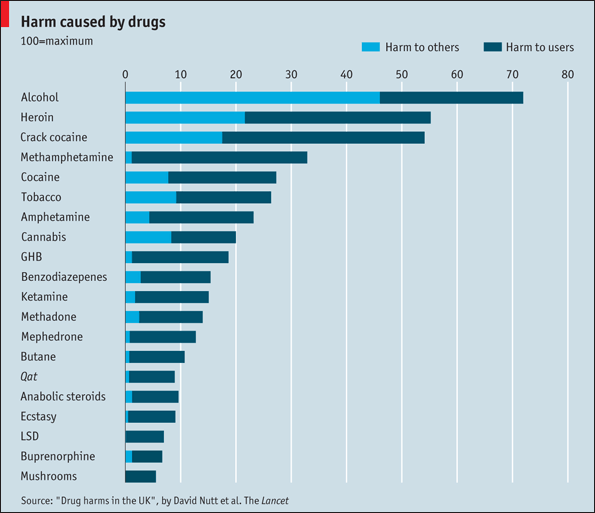
Katelyn G. sent in a link to a story at The Economist about a new study that attempted to measure the harmful effects, to both the user and to the U.K. more broadly, of a number of legal and illegal drugs. The methodology:

Members of the Independent Scientific Committee on Drugs, including two invited specialists, met in a 1-day interactive workshop to score 20 drugs on 16 criteria: nine related to the harms that a drug produces in the individual and seven to the harms to others. Drugs were scored out of 100 points, and the criteria were weighted to indicate their relative importance.

Harm to others included factors such as health care costs, family disruptions, social services, and the cost of criminal justice programs to regulate drugs.

The results? Alcohol outranked all illegal substances they considered by a significant margin, particularly in terms of the harm caused to others:

Will this lead to major changes in drug policy in the U.K.? Unlikely. Here’s a tidbit from an NPR story:

…last year in Britain, the government increased its penalties for the possession of marijuana. One of its senior advisers, David Nutt — the lead author on the Lancet study — was fired after he criticized the British decision.

“What governments decide is illegal is not always based on science,” said van den Brink. He said considerations about revenue and taxation, like those garnered from the alcohol and tobacco industries, may influence decisions about which substances to regulate or outlaw.

(View original at http://thesocietypages.org/socimages)

Posted via email from jimuleda's posterous

Laurens Van der Post

i'm guilty

via Quotes of the Day on 11/13/10

"Human beings are perhaps never more frightening than when they are convinced beyond doubt that they are right."

Posted via email from the Un-Official Southwestern PA Re-Entry Coalition Blog

7 November 2010

The Little Book of Procrastination Remedies

via zen habits by Leo on 11/4/10

Post written by Leo Babauta. Follow me on twitter.

Procrastination is one of those topics that, it seems, I can’t write enough about. There isn’t a person among us who doesn’t procrastinate, and that’s a fact of life.

It’s deep within us. We think we’re going to do something later, or read that classic novel later, or learn French later. But we always overestimate how much we can do later, and we overestimate the ability of our later selves to beat procrastination.

If our current self can’t beat procrastination, why will our future self do it?

I thought I should cover some of the best procrastination-beating strategies, in light of my recent book, focus. People seem to want ways to beat procrastination, so they can actually get down to focusing.

Here’s a quick guide.

Why We Procrastinate

Let’s take a quick look at what makes us procrastinate. There are several reasons, which are related in various ways:

1. We want instant gratification. Resting on the couch is thought of as nicer, right now, than going on a run. Reading blogs is easier, right now, than reading a classic novel. Checking email or Facebook is easier, now, than doing that project you’ve been putting off. Eating chocolate cake is tastier, right now, than eating veggies.

2. We fear/dread something. We might not write that chapter in our book because there are problems with the writing that we haven’t figured out (often because we haven’t thought it through). Or we might be afraid we’re going to fail, or look ignorant or stupid. We’re most often afraid of the unknown, which has more power because we don’t examine this fear — it just lurks in the back of our minds. Dreading or fearing something makes us want to put it off, to postpone even thinking about it, and to do something easy and safe instead.

3. It’s easy – no negative consequences right now. When we were in school and had a teacher looking over our shoulders and scolding us if we didn’t do our work, we tended to do the work (until some of us learned that we could tune out the scolding, that is). But when we got home, sometimes no one would be looking over our shoulders … so there wasn’t any immediate negative consequence to watching TV or playing games instead. Sure, we’d get a bad grade tomorrow, but that’s not right now. The same is true of using the Internet or doing other kinds of procrastination tasks — we’ll pay for it later, but right now, no one is getting mad at us.

4. We overestimate our future self. We often have a long list of things we plan to do, because we think we can do a lot in the future. The reality is usually a little worse than we expected, but that doesn’t stop us from thinking the future will be different yet again. For the same reason, we think it’s OK to procrastinate, because we’re going to do it later, for sure. Our future self will be incredibly productive and focused! Except, our future self is also lazy, and doesn’t do it either. Damn future self.

Four Powerful Solutions

Now that we know the problems, the solutions aren’t that hard to figure out. Just don’t put them off, OK?

1. Stop and think. When we allow the above thoughts to go on without really being conscious of them, we procrastinate. When we actually pause and think about those thoughts, we can rationally see that they’re wrong. Instant gratification in the form of goofing off or eating junk food can lead to problems later. Fears are overblown and shouldn’t stand in our way. Not having negative consequences now doesn’t mean there won’t be consequences later. Our future self isn’t as bad-ass as we like to think. So think about what you’re doing, and start to do the more rational thing. Use the strategies below as well, but thinking is the start.

2. Enjoy the process. When we dread something, we put it off — but instead, if we can learn to enjoy it, it won’t be as hard or dreadful. Put yourself in the moment, and enjoy every action. For example, if you want to go out to run, don’t think about the hard run ahead, but about putting on your shoes — enjoy the simplicity of that action. Then focus on getting out the door — that’s not hard. Then focus on warming up with a fast walk or light jog — that can be nice and enjoyable. Then feel your legs warm up as you start running a little faster, and enjoy the beautiful outdoors. This process can be done with anything, from washing dishes to reading to writing. Enjoy yourself in the moment, without thinking of future things you dread, and the activity can be very pleasant and even fun. And if it is, you won’t put it off.

3. Set up accountability. If no one is looking over our shoulder, we tend to let ourselves slack off. So set up a procrastination-proof environment — find people to hold you accountable. I joined an online fitness challenge this month, for example, so that I’d report my workouts to the forum. I’ve done the same thing for running, quitting smoking, writing a novel. You can even just use your friends and family on Facebook or email.

4. Block your future self. Your future self is just as likely to put things off. So block that sucker. Use a program like Freedom to block your Internet access for a predetermined amount of time, so your future self has to actually focus instead of reading blogs. Turn off your cable TV, get rid of the junk food in your house, cut up your credit cards … do whatever it takes to make it really hard for your future self to procrastinate or give in to temptation, or at least force your future self to pause and think before he does anything dumb.

A Different Mindset

Three other things that must be said about procrastination:

1. Do what excites you. If you do what you’re excited about most of the time, you’ll be less likely to put it off. Focus on why it excites you, rather than the dreaded aspects of the activity. I do this and my procrastination is lower than ever.

2. Productively procrastinate. If you’re going to procrastinate, do other productive things instead. So if you don’t want to do your project, at least get some smaller tasks done. Read more.

3. Sometimes, procrastination is OK. I’m not anti-procrastination, at all. This guide is for those who want to beat it, but in my book, lazing around can be a beautiful thing. Reading stuff on the Internet that I’m interested in isn’t a bad thing. Sometimes, give in to procrastination. But other times, you might want to get off that lazy butt and actually accomplish something.

—
Bloggers: If you’d like help creating amazing content for your blog, I’m running a Blogging Bootcamp starting Nov. 8 — and the first week is free. Read more: How to Write Like an A-List Blogger.
—
If you liked this guide, please bookmark on Delicious or share on Twitter.

Posted via email from the Un-Official Southwestern PA Re-Entry Coalition Blog

Talk2Me

be here-Now!

into the Gaping Void

My Friend Flickr

Talk Gone Wrong

Drop-off Box

drop.io: simple private sharing
Powered By Blogger

plan2planet

Blog Archive