community Service means Business!

18 October 2010

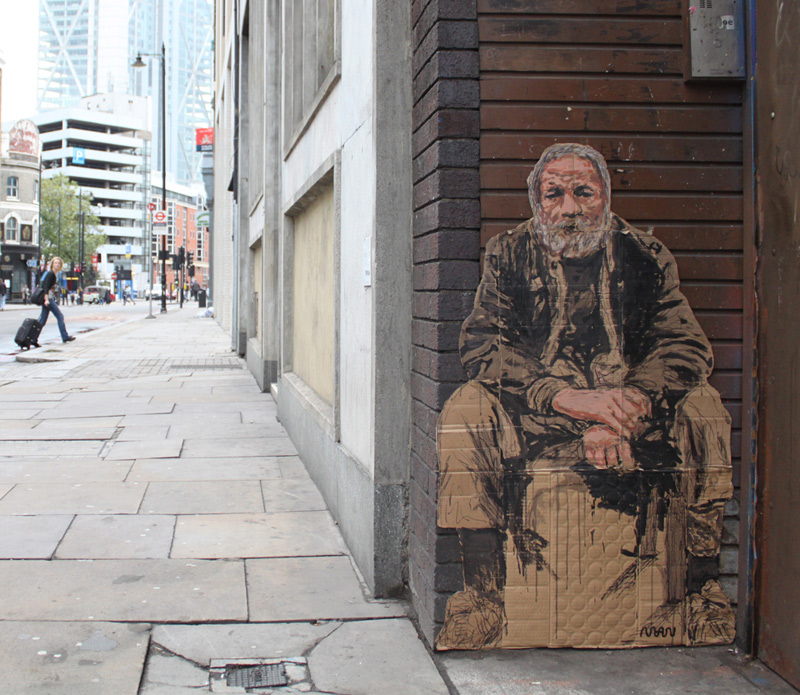
Seen On The Streets Of London

via Wooster Collective by Marc on 10/18/10

London-7.jpg

From Michael Aaron Williams:

"This series are all done on cardboard and depict the homeless. They are put up and are able to be taken down so that they can be taken home. They are therefore extremely delicate. Its interesting because just like the actual homeless, the people on the street ignore the pieces and many times see no worth in them. However, Some people have and are encouraged to take these home where the pieces can survive."

Posted via email from the Un-Official Southwestern PA Re-Entry Coalition Blog

The Double Food Pyramid

via GOOD by Peter Smith on 10/18/10

food-pyramid

The newly formed Barilla Center for Food & Nutrition unveiled a new food pyramid last week, showing the environmental costs of the more familiar-looking food pyramid. No real surprise, then, that the inverted environmental food pyramid illustrates how the most environmentally-friendly foods also tend to be the healthiest.

Barilla, the research spin-off of the Italian food manufacturer, examined the Life Cycle Assessment of various foods and ranked their ecological footprint in an attempt to visualize a sustainable diet. The current design has the feel of a corporate slide show, but the concept—a graphic representation of food's environmental impact—is certainly worth exploring further, especially as the United States reconsiders the abysmal failure of its current design: MyPyramid.

Posted via email from the Un-Official Southwestern PA Re-Entry Coalition Blog

11 October 2010

Slate Article: The United States of Inequality

Where do I stand?
Enter your zip code and income to find out where you fall on the curve.


How you compare:


$52,059

Sources: American Community Survey (State and National Data), IncomeTaxList (Zip code data).
NOTE: All information you enter is private and will not be recorded or stored in any way.

A more thoughtful version of the income-doesn't-matter argument surfaces in my former Slate colleague Mickey Kaus' 1992 book The End of Equality. Kaus chided "Money Liberals" for trying to redistribute income when instead they might be working to diminish social inequality by creating or shoring up spheres in which rich and poor are treated the same. Everybody can picnic in the park. Everybody should be able to receive decent health care. Under a compulsory national service program, everybody would be required to perform some civilian or military duty.

As a theoretical proposition, Kaus' vision is appealing. Bill Gates will always have lots more money than me, no matter how progressive the tax system becomes. But if he gets call! ed to jury duty he has to show up, just like me. When his driver's license expires, he'll be just as likely to have to take a driving test. Why not expand this egalitarian zone to, say, education, by making public schools so good that Gates' grandchildren will be as likely to attend them as mine or yours?

But at a practical level, Kaus' exclusive reliance on social equality is simply inadequate. For one thing, the existing zones of social equality are pretty circumscribed. Neither Gates nor I spend a lot of time hanging around the Department of Motor Vehicles. Rebuilding or creating the more meaningful spheres—say, public education or a tr! uly national health care system—won't occur overnight. Nurturing the social-equality sphere isn't likely to pay off for a very long time.

Kaus would like to separate social equality from income equality, but the two go hand in hand. In theory they don't have to, but in practice they just do. Among industrialized nations, those that have achieved the greatest social equality are the same ones that have achieved the greatest income equality. France, for example, has a level of income inequality much lower than that of most other countries in the Organization for Economic Cooperation and Development. It's one of the very few places where income inequality has been going down. (Most everywhere else it's gone up, though nowhere to the degree it has in the United States.) France also enjoys what the World Health Organization calls the world's finest! health care system (by which the WHO means, in large part, the most egalitarian one; this is the famous survey from 2000 in which the U.S. ranked 37th).

Do France's high marks on both social equality and income equality really strike you as a coincidence? As incomes become more unequal, a likelier impulse among the rich isn't to urge or even allow the government to create or expand public institutions where they can mix it up with the proles. It's to create or expand private institutions that will help them maintain separation from the proles, with whom they have less and less in common. According to Jonathan Rowe, who has written extensively about social equality, that's exactly what's happening in the United States. In an essay titled "The Vanishing Commons" that appeared in ! Inequality Matters, a 2005 anthology, Rowe notes that Congres s has been busy extending copyright terms and patent monopolies and turning over public lands to mining and timber companies for below-market fees." In an 'ownership' society especially," Rowe writes, "we should think about what we own in common, not just what we keep apart."

Inequality doesn't create unhappiness. Arthur C. Brooks, president of the American Enterprise Institute, argued this point in National Review online in June. What drives entrepreneurs, he wrote, is not the desire for money but the desire for earned success. When people feel they deserve their success, they are happy; when they do not, they aren't. "The money is just the metric of the value that the person is creating."

Brooks marshaled very little evidence to support his argument, and what evidence he did muster was less impressive than he thought. He made much of a 1996 survey that asked people how suc! cessful they felt, and how happy. Among the 45 percent who counted themselves "completely successful" or "very successful," 39 percent said they were very happy. Among the 55 percent who counted themselves at most "somewhat successful," only 20 percent said they were happy. Brooks claimed victory with the finding that successful people were more likely to be happy (or at least to say they were), by 19 percentage points, than less-successful people. More striking, though, was that 61 percent of the successful people—a significant majority—did not say they were "very happy." Nowhere in the survey were the successful people asked whether they deserved their happiness.

Let's grant Brooks his generalization that people who believe they deserve their success are likelier to be happy than people who believe they don't. It makes intuitive sense. But Brooks' claim that money is only a "metric" does not. Looking at the same survey data, B erkeley sociologist Michael Hout found that from 1973 to 2000 the difference between the affluent and the poor who counted themselves either "very happy" or "not too happy" ranged from 19 percentage points to 27. Among the poor, the percentage who felt "very happy" fell by nearly one-third from 1973 to 1994, then crept up a couple of points during the tight labor market of the late 1990s. Hout also observed that overall happiness dropped a modest 5 percent from 1973 to 2000.

Quality of life is improving. This argument has been made by too many conservatives to count. Yes, it's true that an unemployed steelworker living in the 21st century is in many important ways better off than the royals and aristocrats of yesteryear. Living conditions improve over time. But people do not experience life as an interesting moment in the evolution of human societies. They experience it in the present and weigh their own experience against that of the livin! g. Brooks cites (even though it contradicts his argument) a famous 1998 study by economists Sara Solnick (then at the University of Miami, now at the University of Vermont) and David Hemenway of the Harvard School of Public Health. Subjects were asked which they'd prefer: to earn $50,000 while knowing everyone else earned $25,000, or to earn $100,000 while knowing everyone else earned $200,000. Objectively speaking, $100,000 is twice as much as $50,000. Even so, 56 percent chose $50,000 if it meant that would put them on top rather than at the bottom. We are social creatures and establish our expectations relative to others.

Inequality isn't increasing. This is the boldest line of conservative attack, challenging a consensus about income trends in the Unit! ed States that most conservatives accept. (Brooks: "It is factually incorrect to argue that income inequality has not risen in America—it has.") Alan Reynolds, a senior fellow at Cato, made the case in a January 2007 paper. It was a technical argument hinging largely on a critique of the tax data used by Emmanuel Saez and Thomas Piketty in the groundbreaking paper we looked at in our installment about the superrich. But as Gary Burtless of Brookings noted in a January 2007 reply, Social Security records "tell a simple and similar story." A Congressional Budget Office analysis, Burtless wrote, addressed "almost all" ! of Reynolds' objections to Saez and Piketty's findings, and confirmed "a sizable rise in both pre-tax and after-tax inequality." Reynolds' paper didn't deny notable increases in top incomes, but he argued that these were because of technical changes in tax law and/or to isolated and unusual financial events. That, Burtless answered, was akin to arguing that, "adjusting for the weather and the season, no homeowner in New Orleans ended up with a wet basement" after Hurricane Katrina.

That income inequality very much matters is the thesis of the 2009 book The Spirit Level, by Richard Wilkinson and Kate Pickett, two medical researchers based in Yorkshire. The book has been criticized for overreaching. Wilkinson and ! Pickett relate income inequality trends not only to mental and physica l health, violence, and teenage pregnancy, but also to global warming. But their larger point—that income inequality is bad not only for people on the losing end but also for society at large—seems hard to dispute. "Modern societies," they write,

will depend increasingly on being creative, adaptable, inventive, well-informed and flexible communities, able to respond generously to each other and to needs wherever they arise. These are characteristics not of societies in hock to the rich, in which people are driven by status insecurities, but of populations used to working together and respecting each other as equals.

The United States' economy is currently struggling to emerge from a severe recession brought on by the financial crisis of 2008. Was that crisis brought about by income inequality? Some economists are starting to think it may have been. David Moss of Harvard Business School has produced an intriguing chart that shows bank failures tend to coincide with periods of growing income inequality. "I could hardly believe how tight the fit was," he told the New York Times. Princeton's Paul Krugman has similarly been considering whether the Great Divergence helped cause the recession by pushing middle-income Americans into debt. The growth of household debt has followed a pattern strikingly similar to the growth in income inequality (see the final graph). Raghuram G. Rajan, a business school professor at the University of Chicago, recently argued on the New Republic's Web site that "let them eat credit" was "the mantra of the political establishment in the go-go years before the crisis." Christopher Brown, an economist at Arkansas State University, wrote a paper in 2004 affirming that "inequality can exert a significant drag on effective demand." Reducing inequality, he argued, would also reduce consumer debt. Today, Brown's paper looks prescient.

Heightened partisanship in Washington and declining trust in government have many causes (and the latter slide predates the Great Divergence). But surely the growing income chasm between the poor and middle class and the rich, between the Sort of Rich and the Rich, and even between the Rich and the Stinking Rich, make it especially difficult to reestablish any spirit of e pluribus unum. Republicans and Democrats compete to show which party more fervently opposes the elite, with each side battling to define what "elite" means. In a more equal society, the elite would still be resented. But I doubt that opposing it would be an organizing principle of politics to the same extent that it is today.

I find myself returning to the gut-level feeling expressed at the start of this series: I do not wish to live in a banana republic. There is a reason why, in years past, Americans scorned societies starkly divided into the privileged and the destitute. They were repellent. Is it my imagination, or do we hear less criticism of such societies today in the United States? Might it be harder for Americans to sustain in such discussions the necessary sense of moral superiority?

What is the ideal distribution of income in society? I couldn't tell you, and historically much mischief has been accomplished by addressing this question too pre! cisely. But I can tell you this: We've been headed in the wrong direct ion for far too long.

View a visual guide to inequality. Subscribe to this series. Navigate the series from a single page.

Become a fan of Slate on Facebook. Follow us on Twitter.

Timothy Noah is a senior writer at Slate.

Article URL: http://www.slate.com/id/2266025/

© 2010 Washingtonpost.Newsweek Interactive Co. LLC

Posted via email from the Un-Official Southwestern PA Re-Entry Coalition Blog

Homeless, Pregnant, Alone and Scared

via Change.org's End Homelessness Blog by Mark Horvath on 10/9/10

This new video comes from Mark's InvisiblePeople.tv 30-city, 11,000-mile, 75-day road trip, going on now.

"Caution: some content may be offensive." Ka'e k'e's interview from St. Paul, Minnesota, is exactly why I have that disclaimer on InvisiblePeople.tv, where I post my videos. She flat out tells us what life is like on the streets for a young woman.

The disclaimer ends with the sentence, "Our hope is you'll get mad enough to do something." I am sure Ka'e k'e's experience will offend you in some way. She has to sleep with strangers just to survive. It's the better option than freezing outside. Ka'e k'e is pregnant, and because she has "survival sex," she does not know who the baby's father is. I sure hope that gets you crazy mad.

Before you label Ka'e k'e an awful mother, know that she is just one of many young girls having babies on the streets. It's a vicious cycle for many. They don't know how to avoid it and many don't have the choices we take for granted. Having sex with strangers and taking drugs to forget the pain is the only way to survive.

I wish you could see what I see in person. I see a hurting young woman who is screaming for help. She is living the life that her family's socio-economic background gave to her. Most of these young adults come from families who were also homeless, or very close to it.

Offended yet? Mad enough to do something? My videos cannot stop earthquakes. They cannot stop hurricanes. They cannot end drug abuse or domestic violence. I sure wish they could fix the economy. Thing is, with a strong family we can get through every crisis that comes at us. If we worked on fixing family — and for me it was the community of Alcoholics Anonymous that saved my life — we could stop this insane cycle and prevent other young adults from going through the same madness Ka'e k'e lives everyday.

So now that you're offended I pray you will take real action to help the hurting young adults in your community or others. Ka'e k'e is staying at the Dorothy Day Center in St. Paul, where donations are of course welcomed and needed.

Posted via email from the Un-Official Southwestern PA Re-Entry Coalition Blog

Snitching Study

via Snitching (Natapoff) on 10/9/10

Dr. Rick Frei, a professor at the Community College of Philadelphia, recently conducted a study ("The Snitching Study") of over 1,500 community college students to determine whether there was widespread agreement among the students as to the definition of "snitching," and what factors would increase or decrease the likelihood that a student would "snitch" on someone they knew to have committed a crime. Professor Frei also testified before the United States Senate’s Subcommittee on Crime and Drugs as to the result of his survey.

The study confirmed that most students (82.6%) regarded "ratting on someone else to get out of a crime" as snitching; whereas less than a third (28.6%) regarded "picking a suspect out of a police lineup" as snitching. While that last figure still seems higher than optimal, it is perhaps explained by another of the survey’s findings, that "half the sample said they did not trust the police," even though 60% of respondents claimed to know a police officer personally.

Two factors in particular stood out for me. First was that "[t]he more the situation required the person to take the initiative … the more likely it was to be viewed as snitching." (Dr. Frei’s Testimony before the Subcommittee). Least likely to be viewed as snitching (16%) was '[a]nswering questions from the police if you are at the scene of the crime." Here, the student’s definition of snitching seemed to track the ACLU's distinction between acting as an informant and acting as a witness. That may have important ramifications for the manner in which the police engage in gathering evidence from people with knowledge of criminal activity.

The second striking factor from the study was that "[n]early half of all students said that they would be more likely to cooperate if there was someone besides the police to which they could report crimes." This factor appears to bolster the idea that the students surveyed tend to distrust the police, or perhaps what the police would do with the information — many students were less likely to snitch if the crime was non-violent. One obvious response would be to set up tipster hotlines that are not directly identified with the police, and which individuals reporting crimes could use to report incidents. Another way to approach the same problem may be to make such tipster hotlines anonymous. Anonymity impacts the most important factor inhibiting the students from acting as informants: almost thirty percent of students said they would be less likely to snitch if it would affect their reputation in the community. There are some worrying practical and legal problems with hotlines, however, and in particular anonymous tips, that I shall consider in a later post.

Posted via email from the Un-Official Southwestern PA Re-Entry Coalition Blog

24 September 2010

1 Year Anniversary of Being out. A Warning.

via Prison Talk by bhoney29 on 9/24/10

I am not the best writer, but I want to share my experience as my boyfriend has been out of prison for one year this week.

My boyfriend spent two years in prison. It's hard for me to talk about his crime because to most people it sparks instant judgement.

Here goes. My boyfriend grew up in Michigan and got his Bachelor's degree in Chemistry. He went to Med School to become a doctor, and moved to Wisconsin to do so. During his first year there, he met a girl at a frat party and had a one night stand. The legal age is 18 in Wisconsin and she was not yet 18. Long story short, he got busted.

I knew him long before this ever happened. We dated when we were both 17 and even a little during the first part of college. We broke up and got back together while he was in prison. It was tough! All the letter writing and phone calls, you know how that is never the same as actually being with someone. But somehow we made it...

He was released in September of 2009. Joy! It was a dream. The first week we were on such a high, I can't remember being happier. Ever since then we have been getting along wonderfully and are very much in love.

Some things I noticed about him. He did not mind spending long periods of time "doing nothing". I would get bored and say "let's DO SOMETHING I'm sooo bored!!" while he would be very, very content to just sit around and watch tv. I feel that is a side effect of spending the two years in prison.

Other than that he seemed perfectly normal. No strange habits or emotional problems. He enrolled in school full time and getting his MBA since he can no longer be a doctor. He sees a counselor once a week. He has had no problems abiding by his parole conditions.

To say it very simply, we are doing very well. However, recently there has been a HUGE, very signicant problem. His PO moved and he got a new PO. I'll get to her in a minute.

Almost to the day exactly, one year after his release, a sweep came by the neighborhood to search our house. Twice a year (in Michigan) they can do a full search, police officers and special "techie" people. My boyfriend was at school, but I was home and had to admit that I own a laptop. They searched it, determined that he had not been using it, and left. But she left a note for him to come see her that Friday (3 days later).

This is what I want to say to everyone who is about to have their loved one come home. GET A COPY OF HIS PAROLE RULES AND READ THEM. FOLLOW EVERY SINGLE ONE OF THEM TO A T, do NOT disobey ANYTHING no. matter. WHAT. For NO REASON, BELIEVE ME. That is my warning.

My boyfriend has never signed a rule saying that there cannot be computers in the house. His PO (who I said I would get to, she is power crazy... I could tell you many stories of what she has said and done to him in the short time he has had her, but that is another story) claims she verbally told him not to have them. I was not aware that me owning a laptop was a violation of his parole conditions. I'm not sure he was even aware, because his old PO knew about my laptop and took no issue with it, as long as it had a password on it and we had a locked area to keep it.

She claims he has violated his parole and has put him in jail. He went to jail today (Friday) and I am to pick him up on Monday morning.

Because his violation occured in Wisconsin, in order for his parole to be revoked they would have to come get him, on their dime. I'm not sure whose decision it would be (judge, parole board, PO????).

His PO is going to send the information (that I had a laptop) to Wisconsin and it will be up to them to decide whether or not to procede with revocation. I think they have a certain time to respond by, but I'm not sure. I'm also unsure why she doesn't keep him locked up until they respond, but I am not about to ask questions. Maybe she knows she doesn't have a case and the overcrowded Wisconsin system would think it a waste of their time to revoke him for such a small incident.


We have done so much together to fix his life, to try to build ours together. He is doing very well in school, he does not use drugs or alcohol. Since his is on the GPS our nights consist of snuggling, moving watchind and board games. Our lives could not be any more wholesome, I would consider him a model parolee (I am biased!). I spent two years fixing my credit so we could buy a house, we worked hard and I ended up buying my first house this year! We moved in over the summer, and we finally felt like we were "building our home" and moving on to a better life.

Please don't take parole for granted. I didn't know his PO had told him "no computers". Know from the begining what he can and can't do. And play by the rules. Do everything you can because keeping your man by your side, physically next to you, is the ultimate goal. I can't tell you how sick I am wondering if I'm going to have the most important part of my life taken away.


One last thing. Nobody is aware of how felons are treated. They don't care. My boyfriend is trying so hard, and he is so well educated and respectful of me and loving towards me. He is really trying to do something with his life. If he is revocated it will ultimatley result in him being even more behind in life, make it even harder for him to finish his education, to get a job and to enter society again as a productive human being.

The country wastes tax payer dollars, thousands per year, keeping him on a GPS unit, money that in our time of economic crisis could be used to put another police officer on the streets to do REAL good. Sending my boyfriend back to prison seems very wrong to me, but nobody will use common sense and realize just how wrong it is.

I feel unheard. I wish there was a way to make the public more aware of situations like this.

Final word. KNOW THE RULES! DON'T TAKE ANYTHING FOR GRANTED! KEEP HIM IN LINE! Kiss him as much as you can. You never know when "they" will be back to take him away.

Posted via email from the Un-Official Southwestern PA Re-Entry Coalition Blog

23 September 2010

Untitled

~~~~~~~~~~~~~~~~~~~~~~~~~~~~~~~~~~~~~~~~~~~~~~~~

Public Policy and External Relations
September 22, 2010
~~~~~~~~~~~~~~~~~~~~~~~~~~~~~~~~~~~~~~~~~~~~~~~~

In this issue:

Cultivating Life Behind Bars

Missouri Tells Judges Cost of Sentences

Inmates Prepare for Outside World Through Reentry Services Program

It's Time to Lift the Ban on Pell Grants for Prisoners

Cultivating Life Behind Bars

By: Sara Schreiber, Officer.com 

~~~~~~~~~~~~~~~~~~~~~~~~~~~~~~~~~~~~~~~~~~~~~~~~~

Work crews sort trash on the recycle line at Stafford Creek Corrections Center. Photo: Roe Simmons

A number of prisons and correctional facilities today are growing their tomatoes and eating them, too. "Green" prisons that incorporate farming and sustainability programs reap real benefits. Aside from saving money and reducing waste, they are also shown to have enormous impact on the inmates themselves -- involving them in a host of maintenance activities and providing useful job skills upon release. Some even argue the programs go a long way in reducing recidivism. Maybe your corrections facility is looking for ways to cut costs and engage its inmate population. If so, on-site gardens and organic farms are a great place to start. But why stop there? Sustainability and green training initiatives can take on many forms.

Getting green off the ground

   From 1853 to 1979 the Southeast Correctional Institution (SCI) in Lancaster, Ohio had detained adjudicated juveniles, and in 1980 became an adult state correctional facility. Around the same time, the minimum to medium security prison adopted a farming operation that continues to be worked by offenders and supervised by a civilian staff. Now SCI, along with Vera Institute and the Ohio Green Prison Project (OGPP), is developing a pilot project to demonstrate that training incarcerated people to retrofit prisons with energy-efficient green technology can make facilities more cost-effective. The project will provide trainees with job skills to prepare them for careers in the burgeoning green economy, making them more likely to succeed when they return to their communities. The lower operating and energy costs are expected to result in savings for SCI and Ohio taxpayers.

Read More

Missouri Tells Judges Cost of Sentences

By: Monica Davey, The New York Times 

~~~~~~~~~~~~~~~~~~~~~~~~~~~~~~~~~~~~~~~~~~~~~~~~~


ST. LOUIS - When judges here sentence convicted criminals, a new and unusual variable is available for them to consider: what a given punishment will cost the State of Missouri.

For someone convicted of endangering the welfare of a child, for instance, a judge might now learn that a three-year prison sentence would run more than $37,000 while probation would cost $6,770. A second-degree robbery, a judge could be told, would carry a price tag of less than $9,000 for five years of intensive probation, but more than $50,000 for a comparable prison sentence and parole afterward. The bill for a murderer's 30-year prison term: $504,690.

Legal experts say no other state systematically provides such information to judges, a practice put into effect here last month by the state's sentencing advisory commission, an appointed board that offers guidance on criminal sentencing.

Read More

Inmates Prepare for Outside World Through Reentry Services Program

By: Amanda Thomas, The Times-Georgian 

~~~~~~~~~~~~~~~~~~~~~~~~~~~~~~~~~~~~~~~~~~~~~~~~~

Ruthie Shelton of the Georgia Department of Corrections speaks to inmates Tuesday at the Carroll County Prison during a Re-Entry Services program ceremony. (Thomas O'Connor/Times-Georgian)

After graduating from the Carroll County NAACP's Re-Entry Services program, 38 inmates returned to their prison lives with new knowledge on how to survive when they return to the outside world.

While not typically a place of celebration, the mood represented at the prison Tuesday night was that of accomplishment as the inmates were congratulated on completing their month in the program, which began on Aug. 17.

The graduates were all smiles as they accepted certificates of completion.

There was no evidence of cliques or animosity toward the system that night as inmates applauded each other on their accomplishments and shared their testimonies on how the program enriched their lives. They talked about finally being provided with a road map that will help guide them on the outside and about the powerful messages they received that inspired them to improve their lives.

Read More

It's Time to Lift the Ban on Pell Grants for Prisoners

By: Jamaal Abdul-Alim, CampusProgress.org 

~~~~~~~~~~~~~~~~~~~~~~~~~~~~~~~~~~~~~~~~~~~~~~~~~

Back in 1994, shortly after 22-year-old Seth Ferranti was sentenced to 24 years in prison for his role as the leader of a drug ring, he took advantage of the Federal Pell Grant in order to get a college education while serving his time.

He was among the last wave of American prisoners to do so.

Even though abundant research found that providing a college education for incarcerated individuals greatly lowers their chances of reoffending, conservative lawmakers-with dubious claims that inmates were depriving law-abiding citizens of Pell grants-ignored the research, denigrated the wishes of the late Sen. Claiborne Pell, father of Pell grants, and in 1994 passed legislation that put the kibosh on federal Pell grants for those behind bars.

Ferranti-now 39, holds an A.A. and B.A., and has become a published author-turned to his parents for the money he needed to continue his college education in prison. But most prisoners, Ferranti says, don't have such resources at their disposal and would benefit greatly from having Pell grants restored.

"There needs to be something in place to allow prisoners that have the drive and ambition to get a college degree to get it," Ferranti adds, speaking via e-mail from the Federal Correctional Institution in Loretto, Penn.

Read More

Follow Us on Twitter! ~~~~~~~~~~~~~~~~~~~~~~~~~~~~~~~~~~~~~~~~~~~~~~~~

Follow @SaferFoundation on Twitter for more updates on criminal justice news and more information about the organization. We appreciate your support! 

Public Policy and External Relations Contacts

~~~~~~~~~~~~~~~~~~~~~~~~~~~~~~~~~~~~~~~~~~~~~~~~

B. Diane Williams, President / CEO

Veronica Cunningham, Vice President, Public Policy and External Relations
Kenneth Clarke, Associate Vice President, Development and Marketing

Anthony Lowery, Director, Policy and Advocacy

phone: 312-922-2200

www.saferfoundation.org

~~~~~~~~~~~~~~~~~~~~~~~~~~~~~~~~~~~~~~~~~~~~~~~~


* Many articles refer to people with criminal records as "ex-offenders" or "offenders". While we appreciate all the positive press these issues receive, we are working to use other terms to describe our clients that do not carry such negative connotations. These terms include "people with criminal records" or "people reentering society".

Posted via email from the Un-Official Southwestern PA Re-Entry Coalition Blog

from the Desk of Debra Germany-Morrison

Hello Everyone,

FYI,

I was recently notified that I will be receiving the Community Service Leadership Award on October 8, 2010. at 6:45 p.m. This will be held at The CAPA High School Performing Arts Theater 111 Ninth Street, Downtown, PA 15222. (See Attached Invitation, Flyer, &  Letter)

I would like to personally extend an invitation to each of you to come out and join me in this celebration and also, join us  in Stopping the Violence in Pittsburgh.  Divine Intervention Ministries and Soul’d Out Productions  wanted to reach out to the families affected by violence and At-Risk Youth committing acts of violence.  We are hosting a Play entitled the Company you Keep.  The Company You Keep is a stage play produced by Soul’d Out Productions that addresses the effects of violence. It will be performed at The Creative and Performing Arts High School (CAPA) Theater from October 8th through October 10, 2010. (See Attachments)

If you know someone in your Family,  Community, Church, or Job, that has been a victim effected by violence or if you know any At- Risk Youth  in your Family,   Church, Community, or Organizations that you are affiliated with, I would encourage  you to invite them to this play.

If you cannot attend the play, but would still like to help out/sponsor someone to attend, please consider making a donation.  The cost of the tickets are $12.00 if you come as my guest.


Our goal is to get the message out to the families and  our young adults that we care about them and that there are other  alternatives to violence.  This play sends a strong message to our young people to Be Careful of the Company you keep.  It will be a night that families can come together and  fellowship knowing that there is still Hope and that Hope is in God.

Please RSVP  at dtm1003@comcast.net or  call 412 303-5043 if you would like to attend the play  or sponsor someone else to attend and I will place your name on my guest list to receive the discounted ticket rate.

Please forward this to all your contacts I need your help getting the word out about this event.

I would like to thank you in advance for your prayers and support.

May God Bless you always,


Debra Germany-Morrison
www.divineinterventionministries.org
412 303-5043

Download now or preview on posterous
SOP Partnership-4.doc (1677 KB)

Posted via email from the Un-Official Southwestern PA Re-Entry Coalition Blog

from the Desk of Debra Germany-Morrison

Hello Everyone,

FYI,

I was recently notified that I will be receiving the Community Service Leadership Award on October 8, 2010. at 6:45 p.m. This will be held at The CAPA High School Performing Arts Theater 111 Ninth Street, Downtown, PA 15222. (See Attached Invitation, Flyer, &  Letter)

I would like to personally extend an invitation to each of you to come out and join me in this celebration and also, join us  in Stopping the Violence in Pittsburgh.  Divine Intervention Ministries and Soul’d Out Productions  wanted to reach out to the families affected by violence and At-Risk Youth committing acts of violence.  We are hosting a Play entitled the Company you Keep.  The Company You Keep is a stage play produced by Soul’d Out Productions that addresses the effects of violence. It will be performed at The Creative and Performing Arts High School (CAPA) Theater from October 8th through October 10, 2010. (See Attachments)

If you know someone in your Family,  Community, Church, or Job, that has been a victim effected by violence or if you know any At- Risk Youth  in your Family,   Church, Community, or Organizations that you are affiliated with, I would encourage  you to invite them to this play.

If you cannot attend the play, but would still like to help out/sponsor someone to attend, please consider making a donation.  The cost of the tickets are $12.00 if you come as my guest.


Our goal is to get the message out to the families and  our young adults that we care about them and that there are other  alternatives to violence.  This play sends a strong message to our young people to Be Careful of the Company you keep.  It will be a night that families can come together and  fellowship knowing that there is still Hope and that Hope is in God.

Please RSVP  at dtm1003@comcast.net or  call 412 303-5043 if you would like to attend the play  or sponsor someone else to attend and I will place your name on my guest list to receive the discounted ticket rate.

Please forward this to all your contacts I need your help getting the word out about this event.

I would like to thank you in advance for your prayers and support.

May God Bless you always,


Debra Germany-Morrison
www.divineinterventionministries.org
412 303-5043

Download now or preview on posterous
SOP Partnership-4.doc (1677 KB)

Posted via email from jimuleda's posterous

22 September 2010

Check out this web page I found with StumbleUpon!

StumbleUpon
View Now >
I found this web page using StumbleUpon and thought you might enjoy it.
hmmm...
Bananas and Monkeys
paws.kettering.edu/~jhuggins/h...
Don't forget to check out my favorite web pages and learn how you can use StumbleUpon to discover great content recommended just for you.

- jimuleda

StumbleUpon is a discovery engine that finds the best of the web, recommended just for you. Learn more

If you do not wish to receive emails sent via StumbleUpon, click here

© StumbleUpon 2001 - 2010

Posted via email from the Un-Official Southwestern PA Re-Entry Coalition Blog

From the Desk of Leanne Aurich

Hello everyone,

I hope your days are going well.

I want to invite you all to Rankin’s Jazz Brunch and Vocal Contest this Saturday at the Rankin Christian Center from 11:00 a.m. – 2:00 p.m.  If you don’t have any plans on Saturday morning, I know RCDC would be delighted to have you there (and so would I!).  It wouldn’t be a Jazz Brunch without the band, which this year is the “Kevin Howard Trio.”  And, of course there will be a raffle, 50/50, and food.  Tickets are only $10 and must be purchased in advance. 

Let me know if you’re interested! 

Thank you,

Leanne

Leanne Aurich                                  

Community Outreach Specialist                

412-464-4000 ext. 4031

laurich@monvalleyinitiative.com

Facebook Page

Twitter

www.monvalleyinitiative.com

Mon Valley Initiative

303/305 East Eighth Avenue

Homestead, PA 15120

"You can't climb the ladder of success with your hands in your pockets."

Posted via email from jimuleda's posterous

From the Desk of Leanne Aurich

Hello everyone,

I hope your days are going well.

I want to invite you all to Rankin’s Jazz Brunch and Vocal Contest this Saturday at the Rankin Christian Center from 11:00 a.m. – 2:00 p.m.  If you don’t have any plans on Saturday morning, I know RCDC would be delighted to have you there (and so would I!).  It wouldn’t be a Jazz Brunch without the band, which this year is the “Kevin Howard Trio.”  And, of course there will be a raffle, 50/50, and food.  Tickets are only $10 and must be purchased in advance. 

Let me know if you’re interested! 

Thank you,

Leanne

Leanne Aurich                                  

Community Outreach Specialist                

412-464-4000 ext. 4031

laurich@monvalleyinitiative.com

Facebook Page

Twitter

www.monvalleyinitiative.com

Mon Valley Initiative

303/305 East Eighth Avenue

Homestead, PA 15120

"You can't climb the ladder of success with your hands in your pockets."

Posted via email from the Un-Official Southwestern PA Re-Entry Coalition Blog

20 September 2010

Poverty Rise Stirs Debate Over Aid Programs (National Public Radio, 09.16.2010)

via National Alliance to End Homelessness by National Alliance to End Homelessness on 9/20/10

The recession drove the number of poor Americans in 2009 to its highest total in half a century, yet several measures indicate the impact could well have been worse.

While the Census Bureau's report Thursday on the economic conditions of U.S. households found that 3.8 million more people lived in poverty last year than in 2008, the agency and advocates for the poor say millions of others were sustained with the help of government programs.

Advocates cite federal stimulus initiatives aimed at low-income earners and the extension of unemployment benefits, which alone are credited with helping keep 3.3 million people out of poverty.

Social Aid, Economic Stimulus

Advocacy groups say the results provide a strong argument for continuing these programs not only as social aid but as a proven method for stimulating the economy.

"The thing about these programs is that they target low-income people, and that money goes back into the economy because they are most likely to spend whatever extra money they get," says LaDonna Pavetti of the Center on Budget and Policy Priorities. "And history shows that poverty levels don't go down until unemployment levels go down. So the worst thing that can happen is to end these programs before we're done needing them."

The findings carry political implications for the Nov. 2 congressional elections, which are expected to be a referendum on such economic policies pushed through by President Obama and the Democratic-controlled Congress.

Gaining momentum from voters frustrated about the economy, Republicans have staked their Election Day ambitions on attacking the Democrats' deficit spending.

As part of its counterstrategy, the White House followed the Census Bureau report with a statement claiming credit for helping to mitigate poverty rates.

"The data released today also remind us that a historic recession does not have to translate into historic increases in family economic insecurity," Obama said in the statement. "Because of the Recovery Act and many other programs providing tax relief and income support to a majority of working families — and especially those most in need — millions of Americans were kept out of poverty last year."

'The Wrong Direction'

Fiscal conservatives say Obama has simply continued costly social aid programs that haven't solved the problem.

"Welfare spending is 13 times bigger than when the war on poverty began, in the 1960s," says Jennifer Marshall of the Heritage Foundation. "Aid to the poor is now the third most expensive government function, and yet we're seeing plans to spend $10.3 trillion over next 10 years. And yet seeing the indicators that poverty continues to go in the wrong direction."

A study released Thursday by the foundation blamed poverty on an increase in single-parent households and entitlement programs that prioritize benefits for unwed parents. The report advocates reducing "anti-marriage penalties" among other initiatives to, as Marshall says, "restore the culture of marriage."

The Recovery Act contained a raft of initiatives aimed at low-income earners such as child tax credits, increased food stamp benefits and emergency block grants issued to states that have helped create about 250,000 subsidized jobs. Advocates are urging the Senate to extend the block grants before they expire on Sept. 30.

Unemployment Benefits Helped

The larger impact on curbing the growth of poverty came from Congress' decision to extend emergency funding to help states continue paying unemployment insurance benefits. Heavy job losses in dozens of states had depleted unemployment insurance funds by early last year.

Unemployment insurance was more effective against poverty than in past years because Congress improved benefits for the longer-term jobless and approved the $25 weekly increase in jobless benefits temporarily granted by the Recovery Act.

Still, the Census Bureau report revealed the broadly harsh impact of last year's downturn.

More than 43.6 million people were impoverished in 2009 — or roughly 1 in every 7 — a 1 percent increase from the year earlier and the largest number recorded in 51 years. The 14.3 percent poverty rate is the highest since 1994 and the third consecutive annual increase.

Poverty rates increased among all racial and ethnic groups, except Asians, across all family structures and all geographic regions except in the Northeast. In addition, the number of uninsured rose.

Given the soaring unemployment rates over the past 16 or so months, most analysts projected poverty rates as high as 15 percent. Many of them also had forecast a decline in median household income, but the Census Bureau said it remained statistically flat, at $49,777.

Moving Back Home

The report also notes a large increase of people who coped with misfortune by bunking with relatives, or "doubling up." For these households, the poverty rate was 17 percent, but it doesn't capture the dire financial conditions of individuals who moved in with family members to save money.

"If you counted the people who moved in — who needed the help — their own poverty level would have been 44.2 percent," said Timothy M. Smeeding, director of the Institute for Poverty Research at the University of Wisconsin.

Smeeding found a particularly dramatic increase in poverty among people ages 25 to 34 who moved in with parents or other relatives. "For those households," he says, "the poverty rate was 8.5 percent. But if young adults' income is taken separately, their poverty rate would have been 42.8 percent. That's an important group."

Posted via email from jimuleda's posterous

Questions or answers

via Seth's Blog by Seth Godin on 9/20/10

You can add value in two ways:

  • You can know the answers.
  • You can offer the questions.

Relentlessly asking the right questions is a long term career, mostly because no one ever knows the right answer on a regular basis.

Posted via email from the Un-Official Southwestern PA Re-Entry Coalition Blog

10 September 2010

Seven Surprising Uses for Baking Soda

via GOOD by Alexandra Spunt on 9/9/10


Let us be clear: Baking soda is not going to permanently cure your acne or turn back the cruel hand of time. But if you’re looking to detoxify your body and your household, this multitasking ingredient will make your life easier (and more beautiful) without denting your coffers. Mom may have taught you that baking soda will make your bread rise and your fridge smell better, but did you know of its many cosmetic applications?

Even the ancient Egyptians—and what beauty post would be complete without them?—used a compound similar to baking soda as soap. The stuff is antiseptic, antifungal, and lightly exfoliating. It will take the stains off your coffee mug and your not-so-pearly whites, and can be consumed internally to ease your tummy ache. And fridge odors aren’t the only smells it absorbs so don’t turn your nose up, and bring on the baking soda!


Brush Your Teeth With It Most conventional toothpastes use sodium lauryl sulfate as their primary ingredient. You may remember this verboten surfactant from previous posts explaining its harsh effects and possible contamination with a carcinogen called 1,4-dioxane. If you don’t want peroxide in your mouth, whitening strips are out too. Go natural instead with some bad-breath-killing-tooth-whitening baking soda on your brush (tastes like the ocean, salty but bearable), or add it to your SLS-free Tom’s for extra-whitening powers.


Wash Your Face With It As a rule, we think that harsh scrubs and exfoliants do not belong on your face—not least of all because you need that top layer of skin to keep bad stuff out and moisture in. Most exfoliating scrubs also contain other sketchy ingredients—like plastic balls. If you’re hellbent on scrubbring, though, at least switch to baking soda. It works great on elbows and feet too, and combined with some raw honey, this DIY face wash is refreshing and soothing—and anti-acne, too.


Create a DIY Deodorant This recipe from our book makes for a pretty effective homemade deodorant. Here’s what we suggest: Mix four tablespoons of baking soda with about ten drops of your favorite essential oil and apply to underarms. Guys, this sounds girly, but there are plenty masculine smells too—like Texas cedar wood. Ladies looking to reapply throughout the day can carry it in their purses: Just fill an empty mineral makeup container with it and use one of those stubby Kabuki brushes for no-mess application.


Spot-Treat Acne Our favorite natural acne remedy is clay, like this green tea one we swear by. But in a bind, making a little paste from baking soda and water and applying it to an unwelcomed visitor will help dry it out. We don't recommend this for deep cysts, but for more surface afflictions, it works like a charm.


Cleanse Your Hair If you’re looking to join the ranks of non-shampooers (we know a few), to reduce how often shampoo, or simply to get rid of some product build-up on your roots, look no further than baking soda. Just fill a glass with warm water and dissolve about a tablespoon of baking soda into it. Take that to the shower, and after wetting your hair pour the mixture through. Comb it well before rinsing—your hair will feel a little coated and slippery until it’s fully rinsed out.


Soothe Your Stomach Acid stomach, heartburn, gas, and other tummy issues are quickly relieved by baking soda because its slight alkalinity can neutralize the acid causing the problem. Just mix a teaspoon into a glass of warm water and drink it down. We swear by this trick.


Soak Your Skin That's right, dissolve some into your bath for a soothing and skin-softening experience. The added bonus? You won't need soap—and sometimes that's a good thing.

Know of any other cool uses for this magic powder?

This is a series inspired by No More Dirty Looks: The Truth About Your Beauty Products and the Ultimate Guide to Safe and Clean Cosmetics, a book by GOOD's features editor Siobhan O'Connor and her co-author Alexandra Spunt.

Read more on their blog

Illustrations by Brianna Harden

Posted via email from the Un-Official Southwestern PA Re-Entry Coalition Blog

9 September 2010

Ten must-read books on prisons and criminal justice reform

Ten must-read books on prisons and criminal justice reform by Kelley October 05, 2008 05:33 PM (PT)

There are hundreds of books on criminal justice out there - from pulp legal thrillers to dry law texts. But somewhere between trashy and arid, we find these 10 gems - must-reads from the last four decades that cover the world's courts and prisons from every angle.

1. Discipline & Punish: The Birth of the Prison (1975)

Michel Foucault

Considered by many to be the greatest work by 20th Century French philosopher Michel Foucault, this book examines the transition in Western countries from execution and torture to mass imprisonment. A prescient classic.

2. Dead Man Walking (1994)

Sister Helen Prejean

This moving personal account of Prejean's moral opposition to capital punishment made her the face of the movement to end the death penalty. In this book, she tells of serving as a spiritual advisor to two Louisiana death row inmates before they are executed. The book was later adapted into a major film starring Susan Sarandon and Sean Penn.

Also by Prejean: "The Death of Innocents - An Eyewitness Account of Wrongful Executions."

3. The Rich Get Richer and the Poor Get Prison (1979)

Jeffrey Reiman

An important textbook by American University philosophy professor Jeffrey Reiman on class inequality in our criminal justice system. Reiman argues that the American criminal justice system punishes the poor while ignoring white-collar crime and injustice.

4. The Gulag Archipelago (1973)

Aleksandr Solzhenitsyn

A personal account of life in the Soviet Union's horrifying labor camps by the late Russian Nobel Laureate Aleksandr Solzhenitsyn, who was imprisoned and then exiled by the Soviet state for his writings. This book is an indispensable examination of human rights violations and the horrors possible in a society that incarcerates millions.

5. Tulia: Race, Cocaine and Corruption in a Small Texas Town (2005)

Nate Blakeslee

The stunning tale of a rash of false and overstated drug arrests in a small Texas town in 1999 that left 20% of the town's African-Americans in jail - many of them completely innocent.  Blakeslee then examines the case to overturn their convictions. This book tells the story of the injustice of America's War on Drugs through a fascinating microcosm. A forthcoming film from director John Singleton is based on the book.

6. In Cold Blood (1966)

Truman Capote

The book that inaugurated the "true crime" genre that continues to fascinate readers around the world today.  It's a classic, gripping character study and a compelling glimpse into the minds of two men who committed several heinous, and seemingly random, murders. Capote captures the reader's attention with wonderful - and sympathetic - profiles of the victims and the men executed for killing them. In the process, he questions the American criminal justice system, its role in creating the two men who committed these murders, and the justice - or lack thereof - offered by the death penalty.

7. Why Our Drug Laws Have Failed and What We Can Do About It - A Judicial Indictment on the War on Drugs (2001)

James Gray

Gray, a prosecutor and judge, offers a fierce and thorough indictment of America's War on Drugs - calling it a waste of time, money and lives. He argues that incarcerating hundreds of thousands of non-violent drug offenders has diverted precious government resources from more important needs, and presents as evidence statistics, case studies, and the words of dozens of participants in all aspects the legal system.

8.  The Nine: Inside the Secret World of the Supreme Court (2007)

Jeffrey Toobin

A surprising page-turner chronicling the current U.S. Supreme Court and how it came to be. Toobin walks readers through the nomination of justices Rehnquist through Alito, and covers the major decisions through this era, comparing the court with its predecessors throughout American history. Toobin focuses on major decisions made by this court and these justices, and renders harsh judgment of what he considers a major blunder by the court in the Bush v. Gore in 2000. Through extensive interviews with former clerks, friends of the justices, and others, Toobin offers a rare backstage view of the most powerful court in the country.

9. Actual Innocence (2000)

Barry Scheck, Peter Neufeld, Jim Dwyer

This book introduced the American public to the new era of criminal justice ushered in by DNA science. The founders of the non-profit Innocence Project (for whom I work), writing with New York Times reporter Jim Dwyer, detail the causes of wrongful conviction as they've been revealed by DNA testing and how these causes play a part in all convictions - not just those involving DNA testing.

10. Courtroom 302 (2006)

Steve Bogira

An extraordinary and memorable account of a year in a criminal courtroom on Chicago's South Side, this book leaves the reader with an insider's knowledge of America's criminal justice system, from the perspective of defendants, guards, judges, defense attorneys, prosecutors and reporters.

Matt Kelley is the Online Communications Manager at the Innocence Project and a graduate of the Medill School of Journalism at Northwestern University.

Jim Reid

jreid@monvalleyinitiative.com

412.464.4000 x4034

SouthWestern PA Re-Entry Coalition Coordinator

Mon Valley Initiative

www.monvalleyinitiative.com

303/305 East Eighth Ave

Homestead, PA 15120-1517

Fax: 412.464.1750

“The problem of crime cannot be simplified to the problem of the criminal”

-Leslie Wilkins

Posted via email from the Un-Official Southwestern PA Re-Entry Coalition Blog

Talk2Me

be here-Now!

into the Gaping Void

My Friend Flickr

Talk Gone Wrong

Drop-off Box

drop.io: simple private sharing
Powered By Blogger

plan2planet

Blog Archive