|
5 March 2011
jimuleda sent you this page: What The Cello And Bass Were Built For: Von Thord - Wedding Night [VIDEO]


jimuleda sent you this page: Rodrigo y Gabriela Diablo Rojo on Vimeo
|


1 March 2011
10 Forms of Twisted Thinking
via World of Psychology by Therese J. Borchard on 2/26/11
 Both David Burns (bestselling author of Feeling Good: The New Mood Therapy and Abraham Low (founder of Recovery, Inc.) teach techniques to analyze negative thoughts (or identify distorted thinking — what psychologists call “cognitive distortions”) so to be able to disarm and defeat them.
Since Low’s language is a bit out-dated, I list below Burns’ “Ten Forms of Twisted Thinking,” (adapted from his “Feeling Good” book, a classic read) categories of dangerous ruminations, that when identified and brought into your consciousness, lose their power over you.
1. All-or-nothing thinking (a.k.a. my brain and the Vatican’s): You look at things in absolute, black-and-white categories.
2. Overgeneralization (also a favorite): You view a negative event as a never-ending pattern of defeat.
3. Mental filter: You dwell on the negatives and ignore the positives.
4. Discounting the positives: You insist that your accomplishments or positive qualities don’t count (my college diploma was stroke of luck…really, it was).
5. Jumping to conclusions (loves alcoholic families): You conclude things are bad without any definite evidence. These include mind-reading (assuming that people are reacting negatively to you) and fortune-telling (predicting that things will turn out badly).
6. Magnification or minimization: You blow things way out of proportion or you shrink their importance.
7. Emotional reasoning: You reason from how you feel: “I feel like an idiot, so I must be one.”
8. “Should” statements (every other word for me): You criticize yourself or other people with “shoulds,” “shouldn’ts,” “musts,” “oughts,” and “have-tos.”
9. Labeling: Instead of saying, “I made a mistake,” you tell yourself, “I’m a jerk” or “I’m a loser.”
10. Blame: You blame yourself for something you weren’t entirely responsible for, or you blame other people and overlook ways that you contributed to a problem.
You can learn more about the 15 common cognitive distortions (e.g., the most common forms of twisted thinking with more in-depth explanations and examples), as well as how you can fix cognitive distortions once you’ve identified them.
Life's Too Short...
via little chief honeybee. by kaelah beauregarde on 2/28/11
I remember seeing this brilliant ad campaign a few years ago, but I only recently stumbled upon a full collection of pictures. This is hands down one of the most well planned and executed campaigns that I've ever seen. While the Sherwin Williams paint-swatch campaign will always have a place in my heart, I'm tempted to say few things have beat this one out. The campaign is for the German job site, Jobsintown.de. If I'm not mistaken these ads go all the way back to early 2006, or even before! The point of the ads is pretty transparent, but that's what makes the impact so powerful. I am in awe. Brilliant use of design!
 They're even borderline creepy! It's as though you just expect them to start moving!What are your thoughts? What are some of your favorite or most memorable ad campaigns?
25 February 2011
New York Times Front Page Suggests that America Dump Black History Month
via Jack & Jill Politics by jilltubman on 2/23/11
 Oh yeah, you heard me right. You can watch it for yourselves though you might need to take a shower afterwards. It’s on the front page of the website even.
John McWhorter of the New Republic says on NyTimes’ Bloggingheads.TV that he’s “beyond Black History Month” and that it’s so “1945 or 1975″. He claims that Americans of all colors roll their eyes at BHM. It’s a ritual and a gesture but not educational.
Glenn Loury of Brown University says he believes Black History Month is “kitsch”, “corny” and “anachronistic”. I don’t know where they found these brothers or what they paid them to say this. I also don’t understand why you would host a conversation like this and not offer one voice in support of Black History Month. Unless you had an agenda in mind.
I guess someone at the Old Grey Lady figures that now that there’s some black history being made every minute in the White House that we don’t need a whole month for them uppity nigras no more. Everyone knows everything they need to know about black history according to McWhorter.

McWhorter and Loury may be willing to throw Black History Month under the very bus where we once had to ride in the back. I couldn’t disagree more strongly and am, in fact, outraged by the suggestion. At a minimum, Black History Month is crucial for young people growing up to understand the contributions of a still-stigmatized population. Furthermore, the success of Black History Month has encouraged other people. Other ethnicities now have months dedicated to their histories here and I’ve appreciated learning more about the challenges and triumphs of Latinos, Native Americans and Asian Americans for example. There’s even Women’s History Month. And I’m not opposed to say, Irish-American History Month or Jewish-American History — there was a time in America when Irish immigrants and their descendants faced vicious discrimination and their strength and courage should be known to all Americans. I’d say these days, we probably could use Muslim-American History Month to tamp down on mounting oppression against that demographic.
How can McWhorter says that he doesn’t believe that America is post-racial and then say in the same breath that Black History Month should be tossed aside. The way that we will overcome prejudice in this nation is through greater tolerance, understanding and yes, even celebration of each other’s cultures and contributions. It’s how we become one nation, indivisible. It’s how kids can see that people just like them — or like their friend sitting next to them — have met incredible obstacles to success and rose above them to do and be great.
Finally Black History Month makes sure that we never forget. A nation that does not know its history is doomed to repeat it and let us never forget the injustice and heartbreak visited upon us. In a time when there are actually conservative leaders who publicly assert that the founding fathers fought against slavery(!) or that the Civil War wasn’t about slavery(!!) or that Jim Crow segregation “wasn’t that bad”(!!!) or that the first black President of the United States somehow isn’t a citizen (!!!!) — Black History Month is needed more than ever to ensure that history isn’t ahem, white-washed or swept under the rug. African-American and really American history is under direct attack by those who would seek to diminish our accomplishments for their own socio-political purposes.
The struggle and success of African-Americans and those who supported them has inspired the entire world. We still have a long way to go, however. Both the poverty and the unemployment rate for African-Americans is twice that of whites. One in three African American children now lives in families that have trouble providing for them.
Are McWhorter and Loury, two privileged black men, really suggesting that those kids don’t need Black History Month? It’s special that they found a couple of uppity nigras to push down on the uppity nigras, ain’t it? The NY Times thinks we’re that stupid.
What do you think? Are you as appalled and disgusted as I am at this attack on Black History Month?
23 February 2011
Social Commentary Through Juxtaposition
via Sociological Images by Lisa Wade on 2/21/11
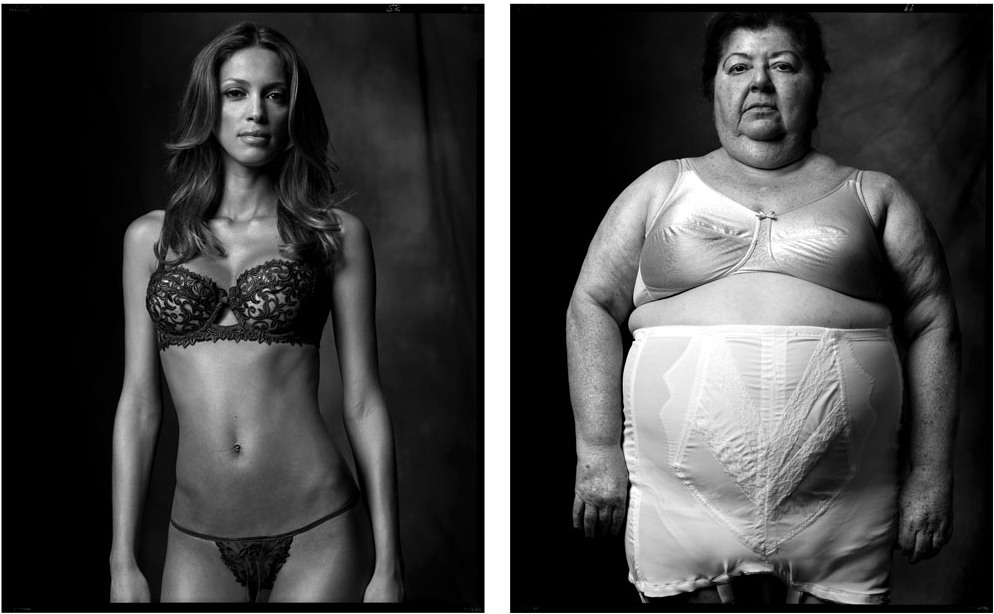
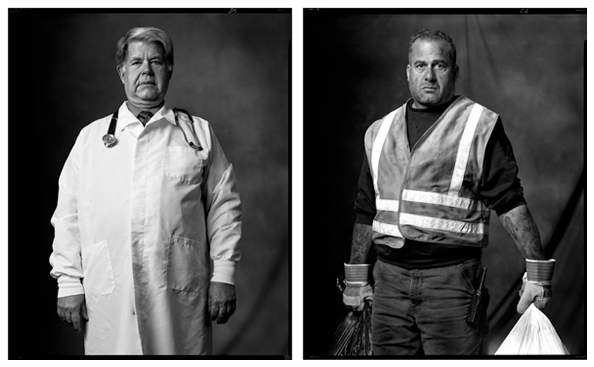
Jordan G. sent in a link to work by photographer Mark Laita. Laita, after long working in advertising, decided that he was tired of producing images that were “nice”:
I felt the need to produce something that was raw and real, as life truly is, not just what we aspire to. The more shocking to our sense of what’s “right,” the better.
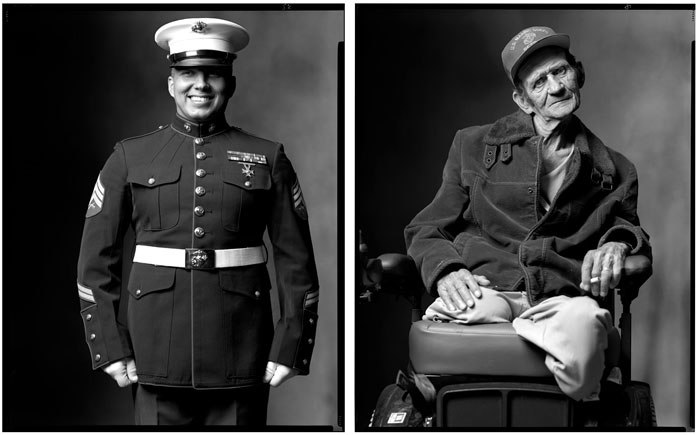
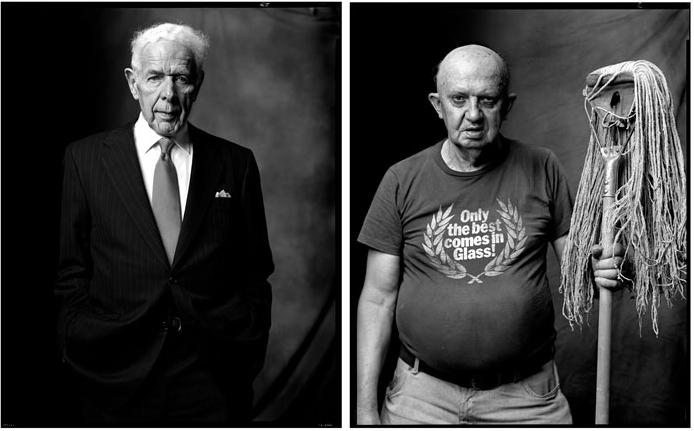
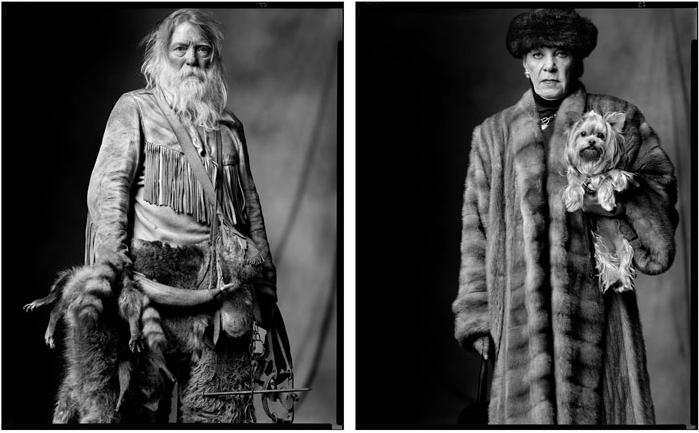
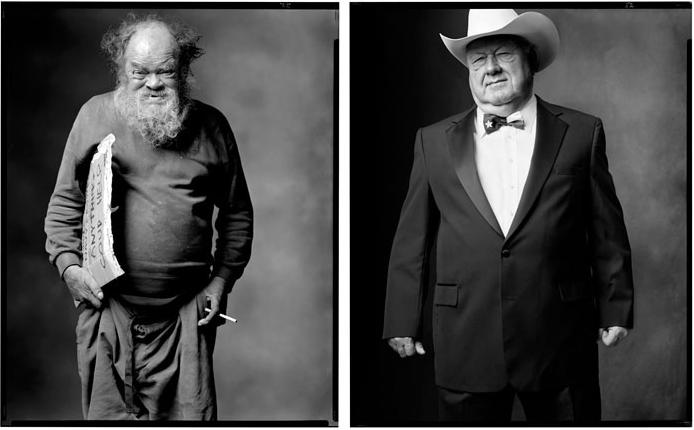
He decided to do so through contrast. In his new photo series, he tries to get us to think by provocatively pairing portraits. They tell us stories about social class, consumption, social sacrifice, and standards of beauty.
Woman in Bar vs. Gold Prospector:

Marine vs. War Veteran:
Company President vs. Janitor:
Fur Trapper vs. Woman with Dog:
Homeless Man vs. Real Estate Developer:
Lingerie Model vs. Woman in Girdle:
Reader Stephanie B., however, wasn’t so charmed by Laita’s work. She felt like he was being controversial without being thoughtful, objecting specifically to this juxtaposition:
Abortionist vs. Garbageman:
Via BoingBoing and Turnstyle.
(View original at http://thesocietypages.org/socimages)
15 February 2011
Black Moses Barbie
rejoice!
via Racialicious - the intersection of race and pop culture by Andrea on 2/15/11
By Sexual Correspondent Andrea (AJ) Plaid
I first saw this on my Twitter pal Ludovic Blain‘s Facebook page and fell off my work stool in laughter. Perhaps I was dead wrong for doing so, but I’ll own it. Check it out:
Black Moses Barbie (Harriet Tubman Commercial) (1 of 3) from pierre bennu on Vimeo.
This is the blurb:
This mock commercial for a Black Moses Barbie toy celebrating the legacy of Harriet Tubman is part of Pierre Bennu’s larger series of paintings and films deconstructing and re-envisioning images of people of color in commercial and pop culture.
Two more commercials for this hypothetical toy will be posted throughout Black History Month 2011.
The transcript after the jump.
Music: Mmmmmmmm (woo woo woo)….Black Moses Baaaar-bieeeee.
Runaway Ken: Oh no! I think we’re lost!
Runaway Christie: (Simultaneously) We’ll never be free!
Black Moses Barbie: Hey kids! Looking for freedom?
Black Ken: It’s Harriet Tubman!
Black Christie: It’s Black Moses!
Black Moses Barbie: On the other side of this tree you’ll find a cave. Go through the cave, make a quick left–
Runaway Ken and Runaway Christie: –mmm hmmmm–
Black Moses Barbie: –and you’ll see a boat.
Runaway Ken and Runaway Christie: –okay–
Black Moses Barbie: Inside of that boat you’ll see a pair of oars…
Runaway Ken and Runaway Christie: …
Black Moses Barbie: …FREEDOM oars!
Runaway Ken and Runaway Christie: WWWOW!
Black Moses Barbie: Paddle north and make your way to freedom.
Runaway Ken: Runaway Christie?
Runaway Christie: Yeah, Runaway Ken?
Runaway Ken: This is all kind of scary.
Black Moses Barbie: Freedom–true freedom–is daunting.
Runaway Christie: I know, Runaway Ken, but–
Black Moses Barbie: –you’ve come this far, but you have to know you’re ready.
Runaway Christie: You know she’s been known to hold a gun on folks who…hesitate.
Black Moses Barbie: I never ran my train off the track–
(Sound of shotgun loading)
Black Moses Barbie: –and I never lost a passenger.
(Pause)
Runaway Ken: (singing) Doo doo de doo be doo doo–
Runaway Christie: (simultaneously) Oookay. Walking, walking, walking to freedom–
Runaway Ken: –for me.
Music: Mmmmmm mmmm mmmmmm.
Announcer: Black Moses Barbie comes complete with Motivational Freedom Rifle. Freedom Oars sold separately.
14 February 2011
Shifting Cultural Sensibilities and Valentine’s Pleas
via Sociological Images by Lisa Wade on 2/13/11
I recently posted a vintage cartoon featuring men showering. Today, in the context of “don’t drop the soap” jokes, it seems obviously homo-erotic (or -threatening). At the time, however, it likely didn’t because homosexuality didn’t hold such a central place in our collective imagination.
Dmitriy T.M. sent along a series of vintage Valentine’s Day cards that, similarly, have a different effect given our contemporary cultural sensibilities. After decades of efforts to draw attention to and problematize men’s violence against women, these cards seem misguided at best:
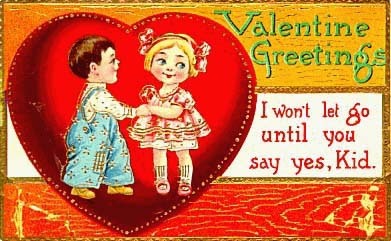
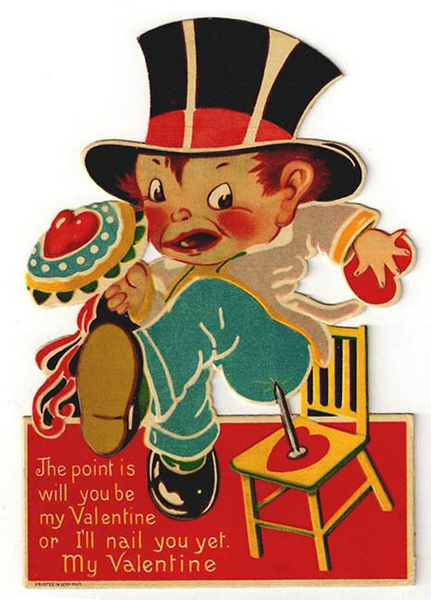
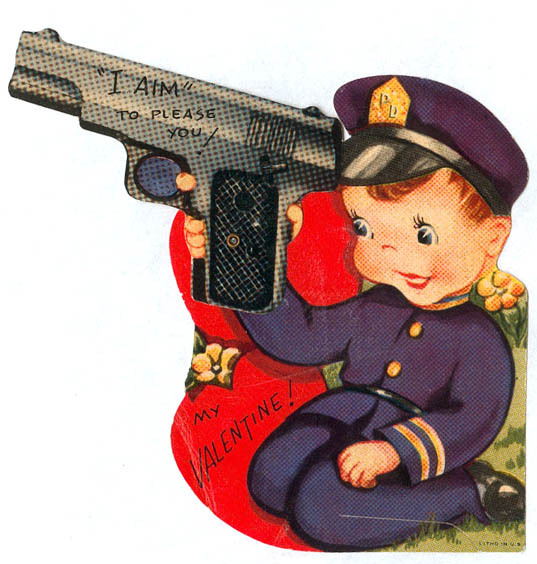
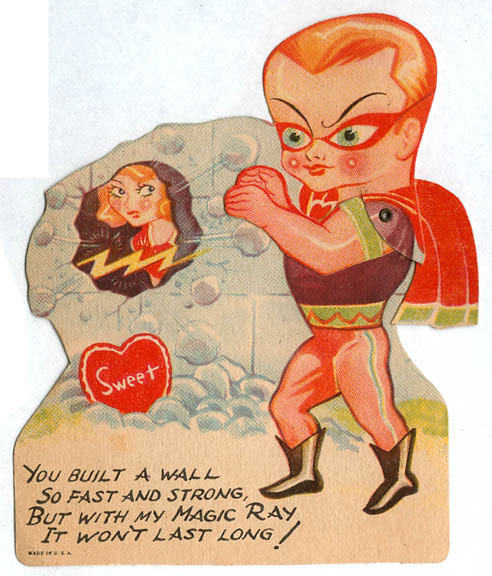
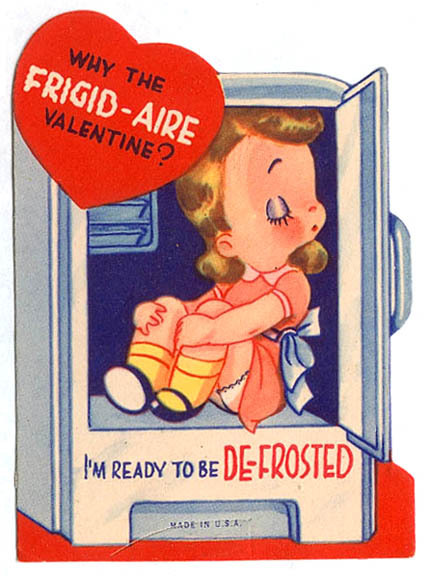
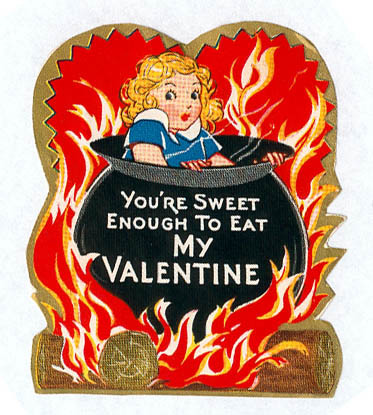

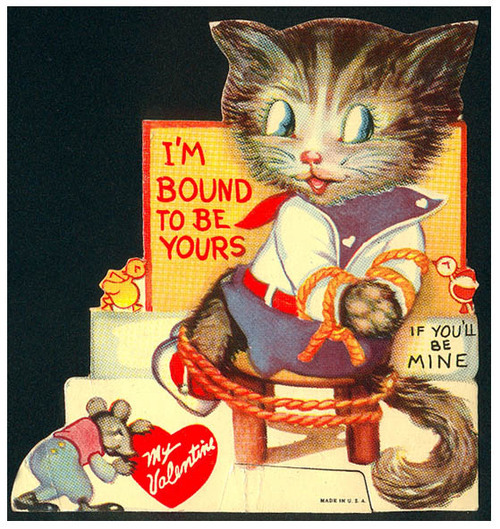
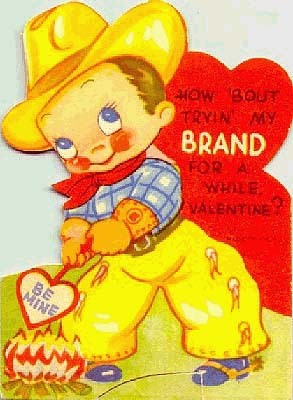
Cards borrowed from Funny or Die.
(View original at http://thesocietypages.org/socimages)
12 February 2011
The History of the Word Rape
via GOOD by Mark Peters on 2/11/11
 The recently abandoned Republican effort to distinguish between "rape" and "forcible rape" sheds light on the word's perceived shades of gray.
Language is always changing, but there are some words that decent, non-evil people want to protect: One is “rape.”
The word "rape" came under attack when Republicans—as part of The No Taxpayer Funding for Abortion Act—tried to make so-called “forcible rape” the only kind of rape that would entitle women to health coverage for an abortion. Jason Linkins summed the issue up well in HuffPo: “People thought this was insane, because it was.” In response to the outrage, the language was changed from “forcible rape” to plain “rape,” making a noxious bill marginally less so. As you probably know by now, the best response to the issue came from the always wonderful Kristen Schaal, who brilliantly spoofed the anti-woman crowd: “You’d be surprised how many drugged, underaged, or mentally handicapped young women have been gaming the system. Sorry, ladies, the free abortion ride is over.”
They politicians eventually dropped the language from the bill, but the situation serves as a reminder that “rape” has always been both a battleground of a word and an atrocity of a crime. I’m not sure a goofball columnist like myself is remotely qualified to deal with the history of this word in English, but I hope I might shed some light on current battles over its meaning. Language always struggles to convey reality, but that struggle is impossible when reality is at its most repugnant.
Over time, the various meanings of “rape” make our current situation seem simple and clear cut. In Old English, a rape was a district in Sussex. In the 1300s “rape” meant the root of a turnip, a type of medieval dish, and a synonym for “speed”—being “in a rape” meant “in a hurry.” Also in the 1300s, the current meaning was first foreshadowed, as the Oxford English Dictionary starts finding examples meaning “The act of taking something by force; esp. the seizure of property by violent means; robbery, plundering.” Sometimes this meant an animal raping—meaning “devouring”—its prey. This 1706 quote shows this seizing, violent meaning in action: “When Kings their Crowns without Consent obtain, 'Tis all a mighty Rape, and not a Reign.” “Rape and pillage” fits with this sense, as does another use from 1673: “Unjust Men! that in your Nameless Pamphlets would Rape us of our Reputation.”
It wasn’t until the 1400s that the sense of “rape” as a man forcing a woman to have sex with him took hold. The word often referred to kidnapping as much as sexual violation: women were “raped away,” in one of many uses of “rape” that is close to “seize.” This is the meaning we find in Alexander Pope's mock-epic poem "The Rape of the Lock," which involves the theft of a lock of hair.
Depending on your time period, culture, country, or state, the legal meaning could vary widely. In more awful times, it used to be considered “impossible” for a husband to rape his wife, as seen in this 1891 quote: “The law allows her husband to commit abduction, imprisonment and rape upon her.” There are many sad footnotes to the history of this word: though “rape-happy” is found back in 1953, “rape counseling” isn’t mentioned till 1972. It's shocking now, but “rape” continued to develop positive meanings over the years, including "To transport with delight, to enrapture." These lines from 1649 could not sound more bizarre today: "One Kisse of hers Makes me contemplate of a future happinesse That rapes me to an Extasie of pleasure."
Aside from congressional scumbags, the blame for a term like “forcible rape” can be laid at the door of other terms like “date rape,” which added shades of grey to the issue of rape—necessary or unnecessary shades, depending on your viewpoint. The similar term “statutory rape” is much older; it’s first found in 1898. Other, recent variations make “date rape” seem forceful by comparison. Grant Barrett’s Double-tongued Dictionary records “bandwidth rape,” which involves the theft of files and info from someone’s Internet connection. There’s also “stay rape,” which is used “...to describe how you feel when someone overstays their welcome. It has the following subsets: Aggravated Stay Rape—When they’re especially annoying. Statutory Stay Rape—When they bring their kids. Date Stay Rape—When it’s a date who won’t leave. You get the idea.” Recently, the TSA’s enhanced pat-downs inspired the term “gate rape.” There are probably dozens or hundreds of similar terms, but I have little interest in looking them up or sharing them with you. I usually can’t get enough of inappropriate language and slangy invention, but I never use a term like “gate rape.” It just seems too insulting to anyone who’s been "rape raped" (as Schaal would put) and to the concept of rape itself. My list of taboo words is smaller than most people’s, but “humorous” rape terms are on it.When thinking about and legislating something as horrible as rape, we have more to fear than tone-deaf politicians who want to make raped women pay for their own rape-caused abortions. language itself lets us down. The lexicographer in me knows that words change and there’s not a damn thing you can do about it. The human being is me feels like it’s important to not to muddy the waters of what “rape” means too much. The real tragedy is that we need such a word at all.
Smoker-free worker
via Cop in the Hood by PCM on 2/10/11
Ahhh, I hear the immortal if overused words of Martin Niemöller... then they started drug testing at work. But I did not complain, because I was not a drug user. Actually, just for the record, I've complained every time I've taken (and passed) a drug test. Well it seems that now there are more places that are drug-testing for cigarettes. That's right. It's not that you can't smoke at work. It's that you can't work and be a smoker. That ain't right. My work and my home life (even when I work from home) are separate. I don't want my boss telling me what I can and can't do when I'm not getting paid. More worrisome is the precedent. This is exactly what people warned about when drug tests were first allowed, thanks to Ronald Reagan's getting tough on drugs. We're the only country that tests people for what they do outside of workplace. First they test for illegal drugs. Then they test for legal drugs. If we don't draw the line, they'll test for fatty foods, kinky sex, and political conformity. It's not right. People are up in arms with real and perceived government abuse of power. Where are the right-wing protesters when big corporations usurp the same power?
11 February 2011
real wood
via Designboom - Weblog on 2/11/11

the chair and footrest feature sloping soft curves, with a frame made from sen wood upholstered with natural leather.
read more
10 February 2011
Bad-Girl in Action or Smart on Crime?
via Jezebel by Margaret Hartmann on 2/10/11


Subscribe to:
Posts (Atom)
be here-Now!

Talk Gone Wrong

